
30 Forgotten Windows Games You’ll Want to Install Immediately
Remember these? Thirty forgotten and overlooked Windows-era PC games that deserve another look, from racing oddities to strategy classics and weird adventures.
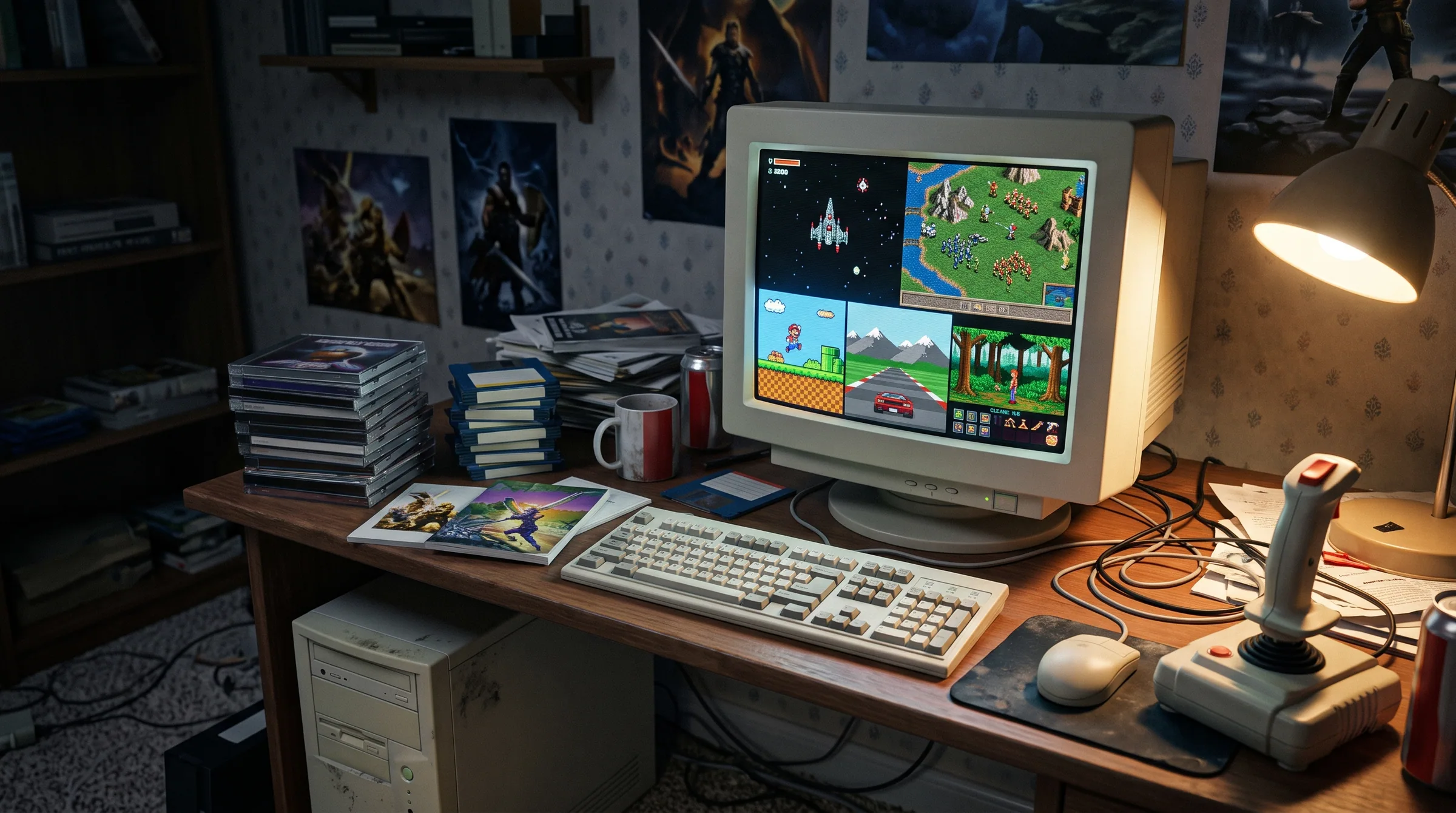
The biggest games rarely disappear.
Doom is still Doom. Age of Empires has modern editions. Diablo became a franchise. Half-Life has been analyzed so extensively that another generation could probably reconstruct Black Mesa from YouTube essays alone.
The stranger fate belongs to the games one level below them: titles that were popular enough to appear on thousands of family computers but not important enough to remain continuously available, remastered and discussed.
They are the games you vaguely remember from a Windows 95 or Windows 98 machine. Perhaps the CD came with a magazine. Perhaps somebody's older brother installed it. Perhaps you played a demo fifty times because buying the full version was not an option.
Not every one of these games is literally unavailable or completely forgotten. "Forgotten" here means far less remembered than its quality or former popularity deserves.
1. Midtown Madness
Before open-world driving became one of gaming's dominant formats, Midtown Madness let players tear around a surprisingly convincing version of Chicago without insisting that they behave like responsible motorists.
The city itself was the attraction. Ignore the race and simply drive around.
That freedom felt remarkable in 1999.
2. Motocross Madness
Another Microsoft racing game from the era, Motocross Madness mixed proper races with the childish pleasure of pointing a motorcycle toward terrain that clearly was not meant to be approached at that speed.
It was accessible, physical and wonderfully good at producing ridiculous crashes.
3. Monster Truck Madness
Before Motocross and Midtown there was Monster Truck Madness, one of those titles whose entire concept could be explained by the box art.
Huge trucks. Ridiculous terrain. Crushed vehicles.
That was enough.
4. Interstate '76
Imagine a vehicular combat game created by people who were deeply committed to making the 1970s look cool.
Muscle cars, guns, funk music, CB-radio dialogue and a stylized American Southwest give Interstate '76 an identity most modern vehicle-combat games would kill for.
5. Future Cop: LAPD
Future Cop occupies the wonderful late-1990s zone where developers were still experimenting with how action games should work in 3D.
You control a transforming police combat machine through urban battlefields. Its Precinct Assault mode is especially interesting in retrospect because its capture-and-defend structure feels like a distant relative of later MOBA design.
6. No One Lives Forever
The Operative: No One Lives Forever deserves to be dramatically easier to buy than it currently is.
It mixes first-person shooting, stealth, gadgets and a parody of 1960s spy fiction into something much more playful than most shooters of its period.
Its legal-rights situation has helped keep it out of modern digital stores, which is one reason an excellent game risks disappearing from mainstream memory.
7. The Neverhood
The Neverhood does not look like almost anything else because almost nothing else was made like it.
Its world and characters were constructed from clay and photographed through stop-motion techniques, giving the adventure a tangible handmade quality that still looks striking.
8. Jazz Jackrabbit 2
PC players did not have to look at console mascot platformers with complete envy.
Jazz Jackrabbit 2 was fast, colorful and extraordinarily smooth, demonstrating that a side-scrolling action game could feel completely at home on Windows.
9. Re-Volt
Remote-controlled cars racing through supermarkets, neighborhoods and toy-like environments remains a fantastic premise.
The small scale transforms ordinary places into race tracks. A curb becomes terrain. A shelf becomes scenery. Household environments acquire the proportions of a full-sized racing world.
10. Ignition
Ignition is an arcade racer viewed from a raised perspective, full of shortcuts, exaggerated vehicles and compact tracks.
It is the sort of game that requires almost no explanation before becoming fun.
11. Claw
Captain Claw—or simply Claw—was a beautifully animated 2D platformer released at precisely the moment the industry was becoming obsessed with polygons.
Its timing probably contributed to its relative obscurity.
The artwork, however, has aged remarkably well.
12. Giants: Citizen Kabuto
Giants is what happens when a development team apparently refuses to decide what sort of game it is making.
There is shooting, strategy, comedy, huge creatures and several dramatically different playable factions.
The result is messy but enormously memorable.
13. Sacrifice
Sacrifice blended action and real-time strategy in a fully 3D world at a time when either one could have been enough to sell a game.
You play a wizard directing creatures while personally moving through the battlefield.
Even today, it does not fit neatly into a genre.
14. Battlezone (1998)
Activision's Battlezone reimagined the arcade name as a hybrid of first-person vehicular combat and strategy.
Rather than hovering above the battlefield like an RTS commander, you are physically inside it, piloting vehicles while building and directing forces.
15. Urban Chaos
Before open-world urban action settled into familiar conventions, Urban Chaos experimented with giving players a city, a police protagonist and a mix of fighting, shooting and exploration.
It is rough by modern standards but fascinating as a snapshot of developers feeling their way toward a genre that would soon become enormous.
16. Sanitarium
Sanitarium is one of the most unsettling adventure games of the late 1990s.
Its protagonist wakes after a car crash in an asylum with little understanding of his identity, and the game proceeds through increasingly strange psychological environments. Interest has survived strongly enough that an enhanced edition was announced for 2026.
17. Outcast
Outcast was extraordinarily ambitious in 1999.
Large outdoor areas, an alien civilization, exploration and an unusual voxel-based rendering approach gave it a visual identity unlike the polygonal games surrounding it.
18. Little Big Adventure 2
Also known as Twinsen's Odyssey in some markets, Little Big Adventure 2 mixed exploration, adventure-game puzzles, action and an eccentric science-fiction world.
Its charm comes partly from how difficult it is to compare directly with anything else.
19. MDK
MDK arrived with an absurd visual identity, enormous levels, bizarre enemies and a sniper mechanic that felt spectacular in the 1990s.
Like many Shiny Entertainment games, it seemed determined to prove that technical experimentation and complete silliness were compatible.
20. Earthworm Jim 3D
This one is not here because it successfully translated everything people loved about Earthworm Jim into 3D.
It didn't.
It is here because imperfect genre transitions are part of PC history too, and Earthworm Jim 3D is a fascinating artifact of the period when nearly every 2D franchise seemed compelled to acquire another dimension.
21. Descent 3
Six-degrees-of-freedom movement remains unusual even now.
Descent 3 allowed players to move and rotate through genuinely three-dimensional environments without a conventional floor dictating orientation. It can still scramble the spatial instincts of people accustomed to ordinary shooters.
22. Aliens versus Predator (1999)
Long before asymmetric multiplayer became fashionable, Aliens versus Predator understood that the interesting part of its license was making its three perspectives feel radically different.
Playing as a marine is not the same experience as playing a predator, and neither resembles controlling an alien.
23. The Journeyman Project series
These first-person adventure games embraced the CD-ROM era's fascination with pre-rendered imagery, video and multimedia storytelling.
Time travel gave the developers an excuse to move across drastically different environments, while puzzles required the sort of careful observation that defined the period.
24. SimTower
SimTower asks you to manage a skyscraper.
That sounds less exciting than managing a city until the elevators become congested, tenants become unhappy and the entire building starts behaving like a vertical transportation puzzle.
Its narrow premise is exactly what makes it interesting.
25. Theme Hospital
Theme Hospital is better remembered than many titles here but still deserves renewed attention.
It turns hospital management into a dark comedy filled with absurd diseases while hiding a genuinely demanding business simulation underneath.
26. Gene Wars
Bullfrog made so many famous games that some of its stranger experiments became footnotes.
Gene Wars lets players manipulate creatures and genetics while competing over ecosystems, an idea strange enough that it would stand out even if released today.
27. Machines: Wired for War
A 1999 real-time strategy game that allowed players to drop into a first-person view and personally control units sounds like a modern indie experiment.
Machines was doing it on late-1990s hardware.
28. WarGames
Loosely connected to the film, WarGames combined real-time strategy with the late-1990s fascination with military technology and computer warfare.
It is not an essential classic, but it belongs to exactly the class of PC game that many people remember seeing on shelves and almost nobody discusses now.
29. Z
The Bitmap Brothers' Z discarded the slow buildup of many strategy games and emphasized fighting over territory immediately.
Its cartoon robot soldiers and aggressive pacing make it feel very different from the resource-heavy RTS formula that later dominated the genre.
30. Beetle Crazy Cup
There was an era when licensed vehicle games did not necessarily behave like serious automotive simulations.
Beetle Crazy Cup took Volkswagen Beetles and placed them into an arcade racing game full of unusual events and cheerful late-1990s presentation.
It is exactly the sort of mid-budget PC game that largely disappeared once development costs rose.
Why did games like these disappear?
Some simply lost to stronger competitors.
Others became trapped by complicated rights ownership.
Several depended on operating-system behavior, graphics APIs or installers that modern Windows no longer handles gracefully.
More broadly, the economics of game development changed. The strange middle class of PC games—the titles too ambitious to be tiny projects but not expensive enough to become enormous publisher franchises—became harder to sustain.
Digital distribution has rescued many older games, but the historical record remains uneven. A famous classic receives remasters, source ports and preservation work. A merely good game can disappear.
That is why revisiting forgotten PC games is so enjoyable.
You are not only revisiting software.
You are rediscovering an era when nobody had completely decided what a PC game was supposed to be.