GTA 6 Is Almost Here, but PC Players Are Still Locked Out. Why Does Rockstar Keep Doing This?
GTA VI launches on consoles in November 2026, but Rockstar still has not announced a PC version. Its history tells us why PC players may be waiting.
For years, PC players have performed the same ritual whenever Rockstar announces a major game. They watch the trailer, inspect every frame, admire the city, argue about the physics, calculate whether their graphics card will survive it, and then reach the platform list at the bottom.
PlayStation.
Xbox.
No PC.
Grand Theft Auto VI has now reached the point where this omission is becoming difficult to ignore. Rockstar's official page lists November 19, 2026 for PlayStation 5 and Xbox Series X|S, and the company opened pre-orders in June. Its newly released 26-minute Extended Look, shown on August 27, was captured entirely from the PlayStation 5 version. Yet Rockstar has still announced no PC release date.
That does not prove that GTA VI will come to PC. Rockstar has not said that it will, and treating an unannounced product as confirmed is how rumor slowly becomes fake news. But if history is useful for anything, it tells us that this situation is extremely familiar.
The more interesting question is not simply when is GTA 6 coming to PC? It is why one of the world's largest game companies continues to launch its biggest titles this way when PC gaming has become far more important than it was twenty years ago.
Rockstar has done this before, and not just once
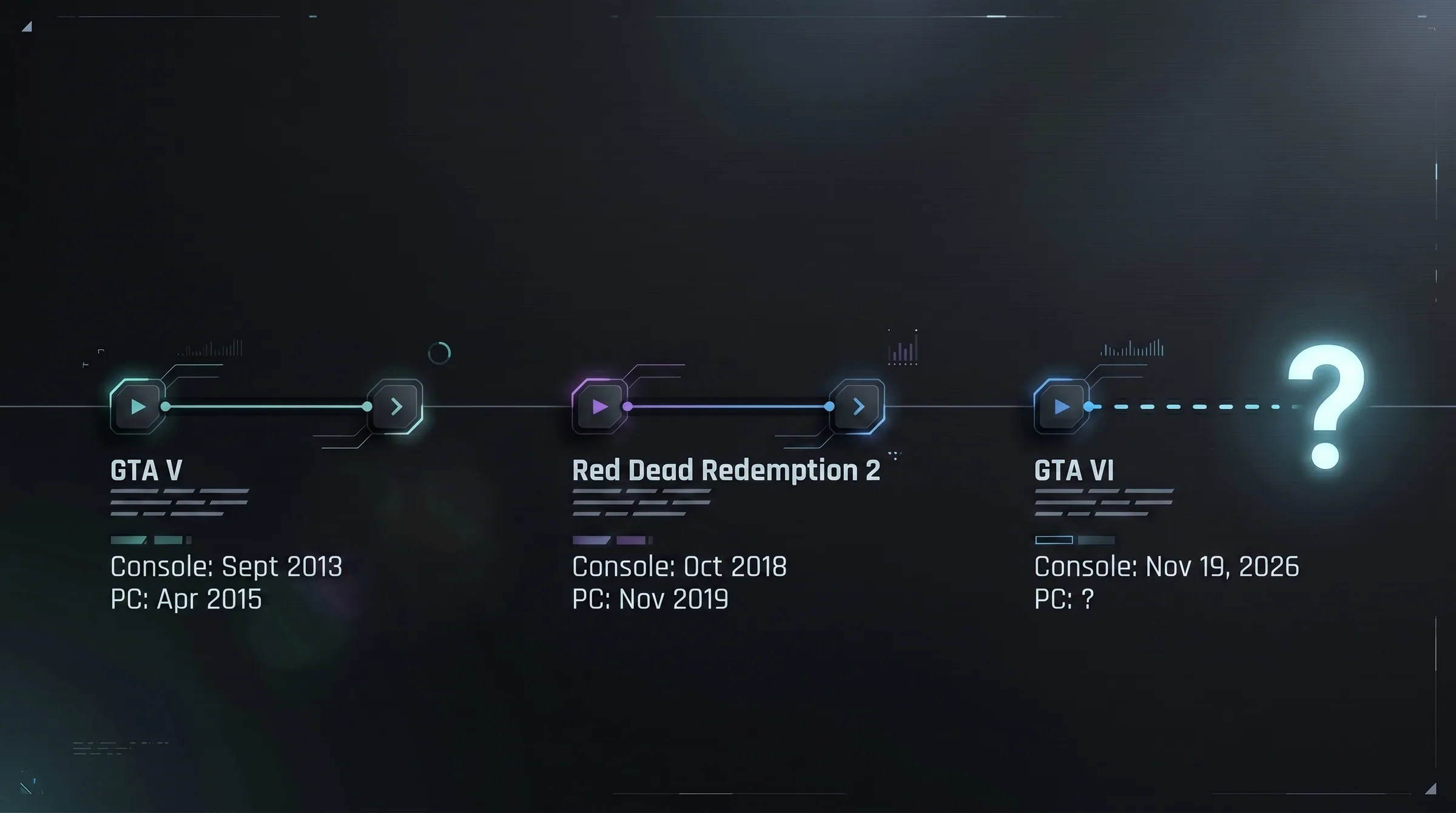
Grand Theft Auto V originally launched for PlayStation 3 and Xbox 360 in September 2013. The PC version did not arrive until April 14, 2015. When it finally appeared, Rockstar did not treat it as a basic conversion. The PC release supported resolutions of 4K and above, 60 fps, extensive graphics controls, mouse and keyboard customization, increased population-density options and multi-monitor configurations.
Red Dead Redemption 2 followed a similar pattern. The console version launched on October 26, 2018. Rockstar announced the PC version almost a year later, in October 2019, and released it on November 5. Again, the company emphasized that the delayed edition contained PC-specific technical improvements, including greater draw distances, improved shadows and lighting, upgraded textures and support for higher-end presentation.
This history makes the current GTA VI situation less mysterious, although not necessarily less irritating. Rockstar has repeatedly treated the PC edition as a distinct production phase rather than simply another box to tick at console launch.
PC is not just another console target
There is a convenient argument that Rockstar simply likes collecting money twice. Release a game on consoles, wait, then sell an improved version to some of the same people on PC.
There is probably some commercial advantage to staggered launches, but reducing the entire strategy to double-dipping ignores a real engineering problem.
A PlayStation 5 is a PlayStation 5. Developers know the CPU, GPU, memory arrangement, storage system, operating-system environment and broad performance characteristics of every machine on which the game will run.
"PC" is not one machine.
A PC version has to live among multiple CPU generations, Nvidia, AMD and Intel GPUs, dozens of driver revisions, wildly different memory capacities, SSD speeds, monitor configurations, peripherals, overlays and background software. The game may have to behave at 1080p on modest hardware and ultrawide 4K on machines that cost several thousand dollars.
That variability becomes particularly important for a game such as GTA VI because Rockstar is not merely drawing prettier streets. The latest official presentation suggests a world packed with pedestrians, vehicles, interiors, water, foliage, physics and activities that must coexist while the player moves through Leonida at speed. Rockstar calls it the "biggest, most immersive evolution" of Grand Theft Auto yet. That is marketing language, but the PS5 footage certainly shows an unusually dense simulation.
Optimizing a dense open world for one fixed hardware target is difficult. Making it behave properly on thousands of PC configurations is a different sort of problem.
The CPU may matter more than PC players expect
When players think about a future GTA VI PC version, discussion naturally turns to graphics cards. Will an RTX 5070 be enough? Will 12GB of VRAM cause problems? Will DLSS be required?
Those are reasonable questions, but GTA VI could become an unusually interesting CPU test.
Open-world simulation involves far more than pixels. Traffic systems, crowds, animation, physics, scripts, audio, streaming logic and world-state updates all require processor time. A stronger GPU can often render a higher resolution or heavier effects, but it cannot automatically rescue a game whose simulation thread cannot prepare frames quickly enough.
This matters when people imagine that the PC edition will trivially turn a 30 fps console game into a 120 fps experience. Higher-end PC hardware offers far more headroom, but doubling or quadrupling the update rate of a complicated simulation can expose bottlenecks that have little to do with graphical resolution.
That could be one reason a later PC release is valuable to Rockstar. By the time a PC edition is being finalized, the console version has already forced the underlying game into a stable performance envelope. PC work can then concentrate on scalability, higher-end settings, input systems and the immense testing matrix that comes with Windows hardware.
The delayed release also gives Rockstar something PC players actually value
There is an uncomfortable truth in this discussion: when Rockstar eventually releases its major games on PC, the PC-specific additions are usually meaningful.
GTA V did not merely arrive with a resolution toggle. Rockstar added extensive visual controls and delivered a version that could run at 60 fps and beyond. Red Dead Redemption 2 similarly gained additional graphical range and PC-oriented enhancements.
A hypothetical GTA VI PC edition could therefore become the version that exposes the game's upper technical ceiling. Higher frame rates, greater draw distances, denser settings, ultrawide support, advanced ray tracing, improved reflections or future reconstruction technologies would all be plausible areas for improvement.
The important word there is plausible. Rockstar has confirmed none of them.
For now, anyone telling you that GTA VI PC will definitely include a particular feature, launch on a particular month or require a particular GPU is filling an information vacuum.

So when should PC players realistically expect GTA VI?
The frustrating answer is that there is no responsible date to give.
GTA V's gap was roughly nineteen months from its original console release to PC, although an upgraded PS4 and Xbox One edition appeared in between. Red Dead Redemption 2's PC version followed the original release by just over a year.
Those two examples do not create a formula.
Rockstar's development pipeline has changed. The PC market has changed. GTA Online has changed the financial importance of the franchise. Modern ports are also more complicated than they were in 2013.
If GTA VI reaches PC, Rockstar could shorten the delay, repeat its Red Dead pattern, wait much longer, or announce something entirely different.
The only firm information as of August 2026 is much simpler: GTA VI launches November 19 on PlayStation 5 and Xbox Series X|S, while Rockstar has not announced a PC date.
The silence may actually be part of the strategy
What is striking is how little Rockstar needs to say.
GTA VI is already one of the most discussed games in the world. A PC announcement made now would become one more detail inside a huge marketing cycle. A PC announcement made after the console launch becomes an event of its own.
New trailer.
New screenshots.
New technical features.
New pre-orders.
New coverage.
Rockstar has used that opportunity before. GTA V's PC marketing focused heavily on 4K, 60 fps and PC-specific options. Red Dead Redemption 2 did something similar with its graphical improvements.
A staggered PC release therefore solves two problems at once. It creates more development time for the most technically variable platform and gives Rockstar another full marketing cycle for a game it has already sold elsewhere.
That explanation is not particularly comforting if your main machine is a PC.
It does, however, make more sense than assuming Rockstar forgot that PC gamers exist.
They almost certainly have not.
History suggests that PC players are not excluded from Rockstar's thinking. They are simply accustomed to being asked to wait outside until the second opening night.