
GTA 6's Jason and Lucia System Could Be Rockstar's Biggest Storytelling Gamble Yet
GTA 6 lets players shape Jason and Lucia's relationship while controlling both characters. It may be far more important than GTA V's character switching.
GTA V's character-switching system looked like something every open-world game would copy.
Almost nobody did.
The reason becomes obvious when you think about how expensive it was. Rockstar had to build three protagonists with separate homes, friends, missions, dialogue, animation, wardrobe, personal vehicles and story arcs, then somehow make the player feel that Michael, Franklin and Trevor continued living while somebody else was being controlled. It was technically impressive, narratively unusual and sufficiently complicated that most developers were happy to leave the idea to Rockstar.
GTA VI is attempting something harder with fewer protagonists.
Jason and Lucia are not merely two playable characters whose stories occasionally intersect. They form a partnership that can operate in missions, in free roam, during crimes, during police escapes and apparently inside a variable relationship system that responds to how much time the player invests in them.
That changes what character switching means.
GTA V's characters were three separate lives
Switch to Michael and you might find him leaving therapy, sitting at home or arguing with his family.
Switch to Trevor and the transition might reveal something completely unhinged.
Switch to Franklin and the game moves into another social world.
Those transitions were excellent because they gave each protagonist independence, but the system primarily emphasized difference. Rockstar wanted the player to experience Los Santos through three people occupying different stages of criminal life.
Jason and Lucia are built around connection.
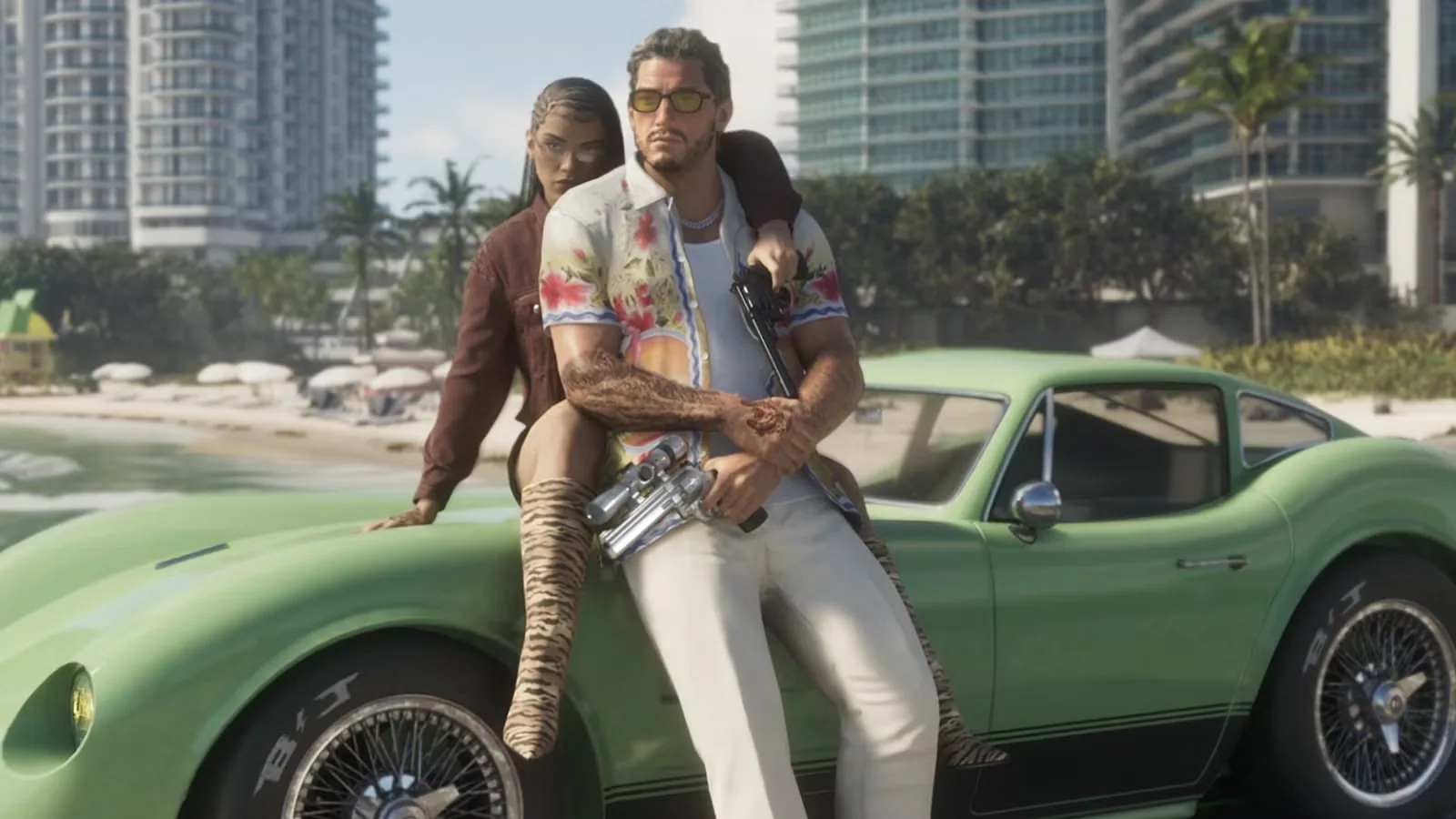
Rockstar's own descriptions make this explicit. Jason is a former Army recruit who ended up working for drug runners in the Keys. Lucia has recently left Leonida Penitentiary and is determined to build a better life. Their story places them inside a conspiracy that forces the pair to rely heavily on one another.
The relationship is not incidental to the plot.
It is the plot's central pressure point.
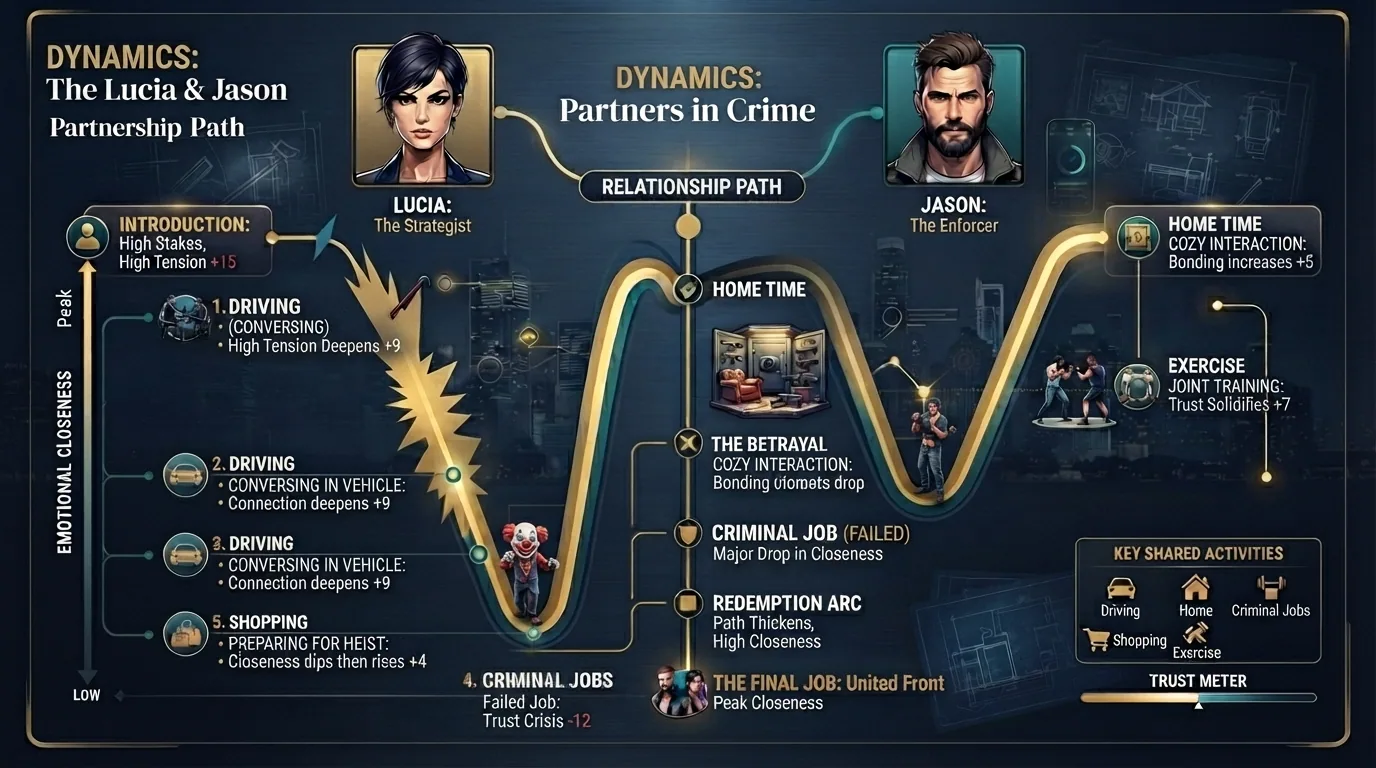
You can apparently spend time together without pretending every moment is a mission
Preview information says one character can call or message the other and arrange to meet. They can shop, exercise, explore and participate in criminal activities together. Their relationship can strengthen through that shared time, although Rockstar says players uninterested in romance do not need to nurture it.
This is an important design choice because forced romance would make the entire system feel artificial.
If every player sees identical romantic development regardless of how they behave, the relationship is simply a scripted storyline with an activity meter attached.
If Rockstar allows the central partnership to have different emotional textures while protecting the broad narrative structure, the game gains something much more interesting.
One player may treat Jason and Lucia as deeply connected partners.
Another may make them feel like two people held together mostly by necessity.
The missions can still occur in both games.
The conversations surrounding those missions do not have to feel identical.
Being together changes how the game works mechanically
The best relationship systems are not contained inside dialogue menus.
Jason and Lucia can apparently operate together during ordinary play. When both are in a vehicle, one can drive while the other shoots. During a police pursuit, the player can exploit their separation. When witnesses know authorities are searching for a pair, splitting up can undermine that description.
This means Rockstar is connecting narrative context to ordinary sandbox systems.
The person sitting beside you is not a generic companion NPC.
They are another protagonist you can control.
That creates fascinating possibilities. Perhaps Lucia drives better in some circumstances while Jason handles a particular weapon loadout. Perhaps one person remains positioned near an escape route while the other enters a building. Perhaps a robbery begins with one protagonist and ends with the player switching to the second character already waiting somewhere strategically useful.
Rockstar has not shown the full limit of these possibilities.
The architecture is already interesting.
Even the ability to let the other person drive matters
One of the smaller reported details is that when Jason and Lucia share a car, the player can potentially occupy the passenger seat while the other character drives.
That sounds mundane until you consider GTA's history.
Driving has traditionally been something the player must constantly do because movement and control are inseparable. Letting the partner drive creates downtime. The game can use that downtime for conversation, scenery, planning or simply allowing the player to exist in the world without manually steering every second.
Red Dead Redemption 2 frequently used travel to create character development. Companions talked while riding. Relationships accumulated through hundreds of conversations that occurred between more dramatic events.
A passenger mode can give GTA VI similar narrative breathing room without slowing its world to horseback speed.
Their lives continue when they are apart
GTA V already experimented with protagonists doing things off-screen. GTA VI seems to be pushing this toward a more coherent simulation.
Preview reports describe safehouses where characters have routines and partners can communicate about what they are doing. The idea is not necessarily to simulate every minute of Jason and Lucia's lives, but to preserve the illusion that the person you are not controlling did not simply cease to exist.
That matters more here because the two characters are emotionally connected.
If Jason has spent the afternoon doing his own thing, then Lucia calls and asks where he has been, the game can turn character switching into relationship texture.
The key will be restraint.
Nobody wants GTA VI to become a romantic Tamagotchi where failing to answer a text within twelve minutes triggers a relationship emergency.
Rockstar appears conscious of that danger. Nelson has emphasized that romantic investment is optional rather than a requirement imposed on players.
The system may give Rockstar a way to make player choice matter without creating twenty endings
Branching narrative is expensive.
Every major fork requires new scenes, dialogue, animation, testing and continuity work. A game with GTA VI's production values cannot casually create hundreds of completely separate campaigns.
Relationship state offers a cheaper and potentially more convincing form of variation.
The broad event remains the same.
Jason and Lucia have to perform a job.
In one player's game, they enter it as a close couple.
In another, their relationship is strained.
The mission geometry does not need to change. Dialogue, gestures, reactions and the meaning of the scene can change.
This kind of accumulated variation is often more believable than a giant menu asking the player to select between Good Ending and Bad Ending during the final ten minutes.
The relationship could also make failure emotionally different
GTA protagonists usually treat danger as occupational inconvenience.
That fits the series' tone, but two playable characters who care about each other create different stakes.
A shootout changes when the person beside Jason is not simply an expendable mission companion. If Lucia is mechanically and narratively persistent, protecting her can feel different even when the game is not explicitly offering a reward for doing so.
Rockstar has said nurturing the romance does not produce a special gameplay bonus.
I like that.
Turning affection into "+10% weapon accuracy when partner nearby" would trivialize the entire idea.
If players invest in Jason and Lucia because they become attached to them, the system has worked without needing a stat buff.
This is the first GTA where "going home" might actually mean something
Safehouses in Grand Theft Auto have traditionally been practical spaces.
Save game.
Change clothes.
Store vehicles.
Perhaps watch television.
GTA VI's relationship structure gives a shared home another function: it can become a recurring stage for the relationship.
A good open-world home works the way Red Dead Redemption 2's camp worked. Players return because they are curious about the people there, not merely because the interface contains something useful.
If Jason and Lucia's safehouses accumulate conversations, changed routines, personal belongings, disagreements and quiet moments throughout the game, Rockstar can make returning home part of the story without formally starting a mission.
That is difficult writing because repetition becomes obvious quickly.
It is also exactly the kind of expensive environmental storytelling Rockstar is unusually equipped to attempt.
GTA VI's entire story may depend on making us care about two people who cannot simply leave
Rockstar's official synopsis says Jason and Lucia become caught in a criminal conspiracy and are forced to rely on each other more than ever.
That creates a built-in tension.
They need one another.
That does not necessarily mean they will always like one another.
A player-controlled relationship system allows Rockstar to explore that difference.
Perhaps GTA VI ultimately ends with the same broad outcome regardless of how affectionate the pair became. Even then, eighty hours of subtly different interactions can make that outcome feel completely different.
The most impressive thing GTA V did with multiple protagonists was allowing us to switch between three lives.
GTA VI may be asking a much more difficult question:
What if switching characters changes the life between them?