
8GB VRAM Is Finally Breaking in 2026, and the Benchmarks Are Getting Ugly
Is 8GB of VRAM still enough for gaming in 2026? New benchmarks show where 8GB cards work, where they struggle, and what buyers should choose now.
For years, arguments about graphics-card memory followed a predictable pattern. Somebody would declare that 8GB of VRAM was dead, somebody else would produce a game running perfectly well on an 8GB card, and the discussion would collapse into insults about settings, optimization and whether anyone really needed ultra textures.
In 2026, the argument has become harder to dismiss.
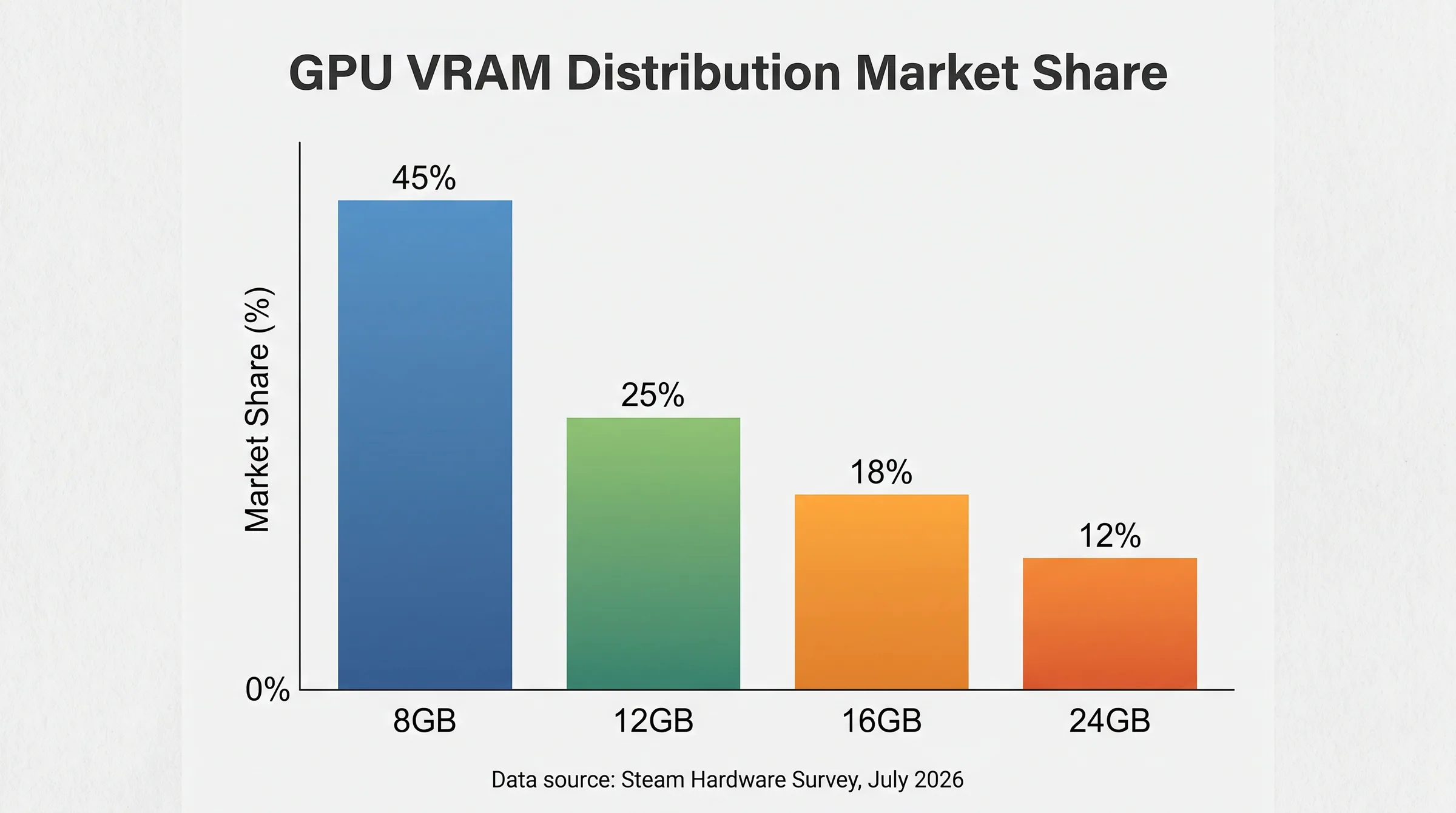
Steam's hardware survey still shows an enormous installed base of 8GB graphics cards, but memory capacity is moving upward. In the July 2026 survey, 8GB represented roughly a quarter of surveyed systems while 12GB and 16GB configurations had become increasingly common. The RTX 3060, RTX 4060 and other cards with modest memory capacities remain widely used, so developers cannot simply pretend these machines disappeared.12
At the same time, modern games are finding increasingly unpleasant ways to react when the VRAM budget runs out.
The question therefore needs to change. Asking "can an 8GB graphics card still play games?" is too crude. Obviously it can.
The useful question is: what compromises begin happening when a modern game wants more video memory than the card can provide?
VRAM is the GPU's working space
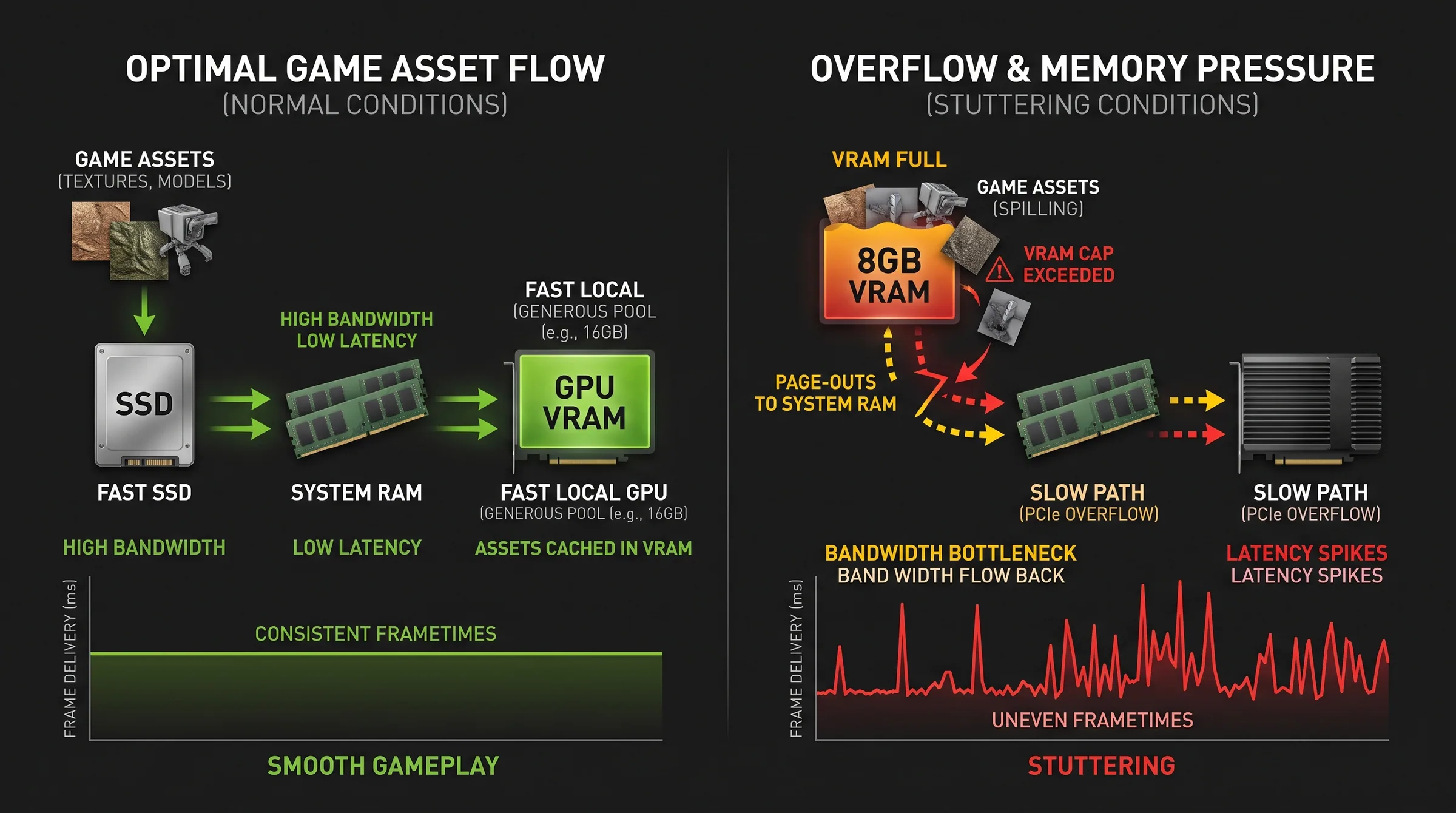
Your graphics card does not constantly fetch every texture, geometry buffer and rendering resource directly from an SSD while drawing each pixel. Assets that the GPU needs quickly are kept in video memory, where bandwidth is vastly better suited to graphics workloads.
That includes texture data, render targets, geometry, shadow information and numerous temporary resources used by modern engines.
When the workload fits comfortably inside available VRAM, life is relatively straightforward. When it does not, the system has to start making decisions.
Some engines reduce texture quality.
Some move resources between VRAM and system memory.
Some exhibit severe frame-time spikes.
Some continue reporting an apparently respectable average frame rate while moment-to-moment motion becomes ugly.
That last case is one reason VRAM problems are frequently misunderstood.
A game averaging 70 fps can still feel awful if individual frames occasionally take dramatically longer than expected.
The most useful 2026 comparison came from identical GPUs
Arguments about memory are often polluted by comparisons between entirely different graphics cards. If one card has 16GB and another has 8GB but also uses a faster GPU, you cannot easily isolate what the memory capacity changed.
The Radeon RX 9060 XT creates a useful test case because AMD sells 8GB and 16GB versions built around the same basic GPU.
TechSpot's testing of Spider-Man 2 showed the 16GB version producing 35 percent higher average performance and a 70 percent improvement to one-percent lows in one memory-constrained test using 16GB of system RAM. Their analysis showed the 8GB card leaning much more heavily on system memory once local VRAM filled.3
A later 2026 examination of Forza Horizon 6 produced even more dramatic results under demanding settings. In an extended 1440p test, the 16GB card finished vastly ahead of the 8GB model, while the memory-limited card also showed reductions in distant scene detail.
That does not mean every game will behave like Forza Horizon 6.
It does mean the old statement "8GB never matters at 1080p or 1440p" is no longer defensible as a universal rule.
Why doesn't every 8GB card immediately collapse?
Because games are adaptive.
A competently designed engine tries to operate within the hardware it finds. Texture streaming systems can load lower-resolution versions. Unneeded assets can be evicted. Settings can be reduced. Ray tracing can be disabled. Internal resolution can be lowered.
This is also why two players can argue endlessly about whether 8GB is "enough" while both are technically correct.
One is playing a competitive title at 1080p medium settings and never approaches the VRAM limit.
The other is playing a new open-world game with high-resolution textures, ray-traced effects and frame generation at 1440p.
They do not have the same workload.
VRAM requirements depend on the game, resolution, texture quality, ray tracing, anti-aliasing method, frame-generation implementation and sometimes even the exact area of a game being tested.
Texture quality is usually the first setting worth watching
High-resolution textures are hungry because developers now create detailed material sets for huge worlds.
A single visible object may use separate texture maps for color, surface normals, roughness, metallic properties and other information. Multiply that across thousands of objects, characters, environmental surfaces and multiple mip levels and the memory footprint becomes substantial.
The interesting thing is that texture quality often has a relatively small effect on raw GPU computation while having a very large effect on memory use.
That means an 8GB card may possess enough shader performance to run a scene but not enough local storage to hold the preferred asset set.
The GPU is strong enough.
Its backpack is too small.
Ray tracing makes the memory argument worse
Ray tracing adds structures and buffers needed to trace geometry and reconstruct lighting. Frame-generation and reconstruction techniques can introduce additional resource requirements as well.
That creates a strange modern situation where technologies marketed as performance boosters can sometimes increase pressure on another part of the card.
Upscaling helps by reducing the resolution at which some work occurs, but it does not magically make high-resolution textures disappear. A game rendered internally below 1440p can still use large texture sets intended for a 1440p or 4K output.
This is why VRAM discussions cannot be reduced to resolution alone.
The Steam numbers explain why developers are stuck
Developers have a problem of their own.
The July Steam survey shows enormous numbers of players still using 8GB-class GPUs. Developers making mainstream PC games cannot simply require 16GB tomorrow without excluding a large portion of their potential customers.
Yet newer graphics cards are moving upward. AMD offers the RX 9060 XT in both 8GB and 16GB forms, while higher models increasingly ship with 12GB, 16GB or more. The RTX 5070, for example, carries 12GB and the RTX 5070 Ti 16GB.4
This creates a transition period in which games need to support older memory budgets while also taking advantage of machines with much more capacity.
We are living inside that awkward transition now.
If you already own an 8GB card, should you panic?
No.
There is an important difference between buying an 8GB GPU in 2026 and owning one.
If your existing card delivers the performance you want, continue using it. Lowering texture quality from ultra to high is often far cheaper than replacing an entire graphics card, and many games remain perfectly comfortable within 8GB.
You should become suspicious when you see abrupt stuttering, textures that take too long to resolve, unusually poor one-percent lows or performance that collapses after extended play. Those symptoms can indicate memory pressure, although they can also have other causes.
Dropping texture quality and ray-tracing settings is a useful diagnostic test.
Buying one today is a different question
For a new gaming GPU intended to last several years, 8GB is becoming difficult to recommend except at the genuinely budget end of the market.
This does not mean 16GB is magically future-proof. No hardware specification can promise that.
It means memory capacity is increasingly capable of becoming the limiting factor before the GPU core itself becomes useless. When the same GPU can be purchased with twice the memory, the larger buffer can preserve texture quality and frame consistency long after both versions have stopped being considered new.
The industry spent years arguing about when 8GB would become a real limitation.
There was never going to be a morning when every 8GB card suddenly stopped working.
Hardware obsolescence rarely arrives like that.
It arrives as a growing collection of compromises.
A texture preset you cannot use.
A ray-tracing option that suddenly stutters.
A game that behaves beautifully for twenty minutes and then begins hitching as the world fills memory.
A new release where the 16GB version of your exact GPU performs inexplicably better.
In 2026, those examples are accumulating quickly enough that the argument is changing.
Eight gigabytes is not dead.
But it has very clearly stopped being comfortable.