
OLED Burn-In Is Not Dead. The 10,500-Hour Test Every Gamer Should Understand
OLED monitors look incredible, but burn-in still exists. New long-term testing shows what has improved, what has not, and how gamers should think about the risk.
OLED gaming monitors have reached the point where almost every old criticism sounds increasingly outdated.
Brightness improved.
Refresh rates exploded.
Pixel response is extraordinary.
Text rendering is getting better.
High-end models now compete directly with esports displays.
This week ASUS announced a 720Hz tandem-WOLED gaming monitor that will become the official display of the 2026 PGL Counter-Strike 2 Major, the first Counter-Strike Major to use OLED monitors on stage.
One old concern, however, refuses to disappear.
Burn-in.
Worse, recent long-term testing suggests the honest answer is more complicated than either side of the internet argument wants.
OLED burn-in is still real.
That does not mean you should avoid OLED.
What burn-in actually is
An OLED display differs fundamentally from a conventional LCD because each pixel produces its own light.
That gives OLED its famous advantages.
Black pixels can switch off.
Contrast is extraordinary.
There is no LCD backlight bleeding through dark scenes.
Pixel transitions can be extremely fast.
The downside is that the organic light-emitting materials age as they are used.
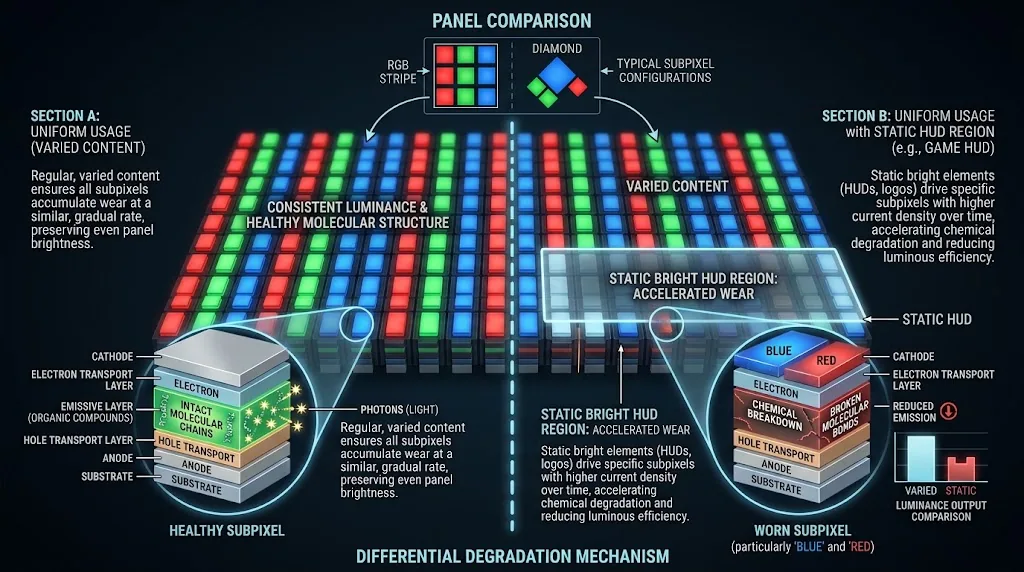
If one area of the screen repeatedly displays bright static content while another area changes constantly, the pixels do not age identically.
Eventually that uneven wear can become visible as a persistent pattern.
A television channel logo.
Windows taskbar.
Game HUD.
Scoreboard.
Health bar.
That permanent differential aging is the issue people normally mean by burn-in.
Temporary image retention is related but not identical. A temporary retained image can fade as the display recovers. Permanent burn-in does not simply disappear after leaving the monitor off for twenty minutes.
The long-term tests produced an uncomfortable result
RTINGS has been running accelerated longevity testing on OLED displays for years.
In an August 2026 update, the site compared newer OLED televisions with its older 2017 LG C7 test after equivalent heavy-use periods.
Their conclusion was not that modern OLED had become dramatically immune.
At the 10,500-hour checkpoint, newer OLED generations did not show a consistent reduction in visible permanent image retention compared with the older set in the previous testing regime.
That headline sounds frightening until you understand the rest.
Newer OLEDs are significantly brighter.
Panel structures, compensation systems and thermal management improved.
Producing much higher brightness while showing similar burn-in behavior under brutal accelerated usage indicates that resilience relative to output has improved even if the visible end result did not vanish.
The technology progressed.
Physics did not surrender.
Gaming is both good and bad for OLED longevity
Gaming content is dynamic.
Cameras move.
Scenes change.
Menus open and close.
Colors vary.
That is good for OLED because wear gets distributed.
Games also contain some of the most aggressively static interface elements imaginable.
Health bars.
Mini-maps.
Ammo counters.
Ability icons.
Scoreboards.
Crosshairs.
If somebody plays the same competitive game for thousands of hours with an unchanged HUD, those bright elements can accumulate disproportionately high usage.
The important variable is therefore not merely hours of gaming.
It is how repetitive those hours are.
Four thousand hours spread across dozens of games, movies, browsing and desktop work is a different workload from four thousand hours of one title with a bright static scoreboard.
Monitor use can be harsher than television use
A television regularly displays full-screen moving images.
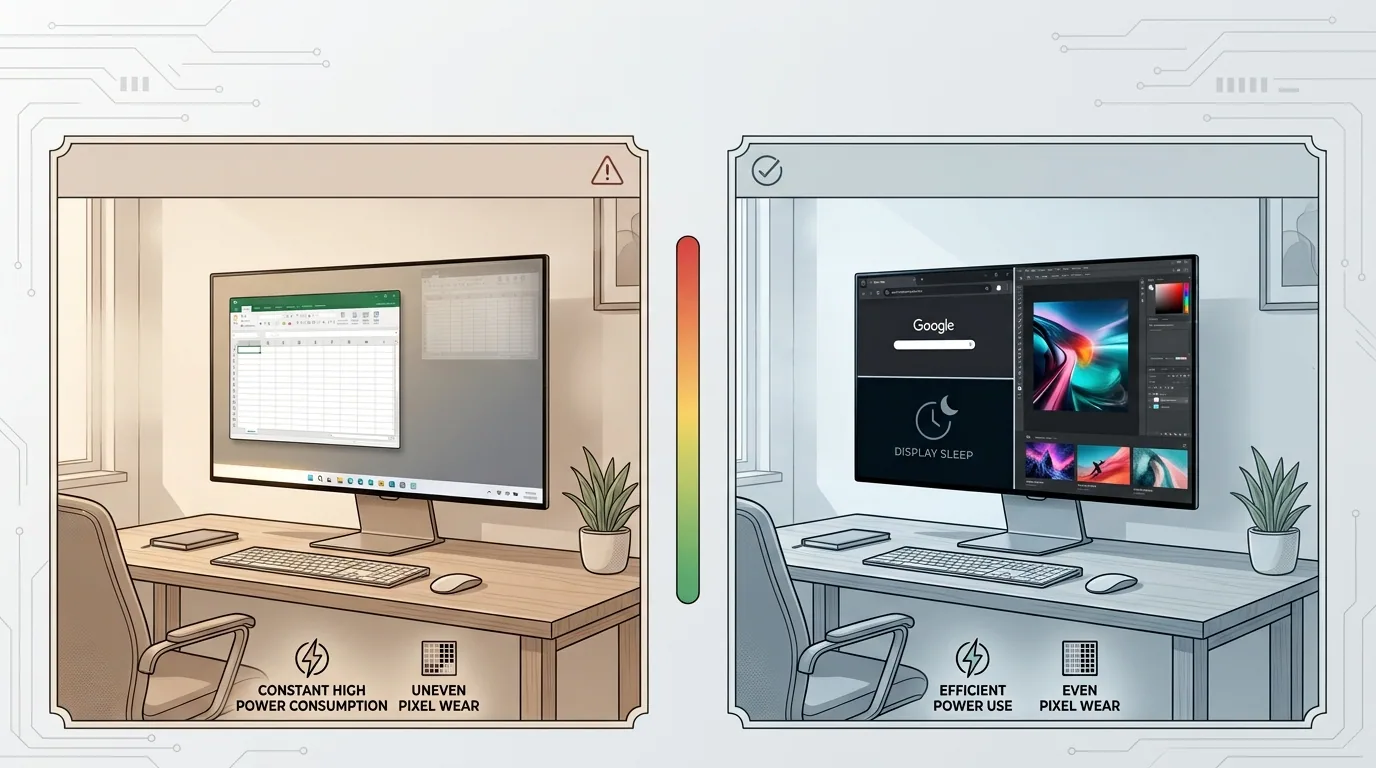
A desktop monitor may show the same taskbar eight hours per day.
Browser tabs stay in fixed positions.
Application toolbars remain visible.
Window borders barely move.
This is why OLED monitor manufacturers use protective strategies such as pixel shifting, compensation cycles, static-element detection and automatic dimming.
ASUS's newly announced esports OLEDs even advertise dedicated OLED-care features and thermal design intended to extend panel lifespan.
Those systems are useful.
They are not force fields.
Should you hide your taskbar and use a black wallpaper?
If OLED longevity matters greatly to you, reducing unnecessary static high-brightness content is sensible.
Auto-hide the taskbar.
Use a screen saver or short display-sleep timer.
Avoid leaving a bright desktop sitting unused for hours.
Let the monitor complete its compensation cycles.
Do not disable panel-protection features because they mildly annoy you.
Use reasonable brightness for ordinary desktop work.
None of this requires treating your monitor like a museum artifact.
The goal is simply to avoid wasting panel life displaying the same bright elements when nobody is benefiting from them.
What about competitive gaming?
This is where OLED's advantages have become too large to ignore.
OLED pixel response is extraordinarily quick compared with conventional LCD behavior.
High refresh rates amplify that strength.
The new 24.5-inch ASUS PG259QWS reaches 720Hz with a quoted 0.02 ms response time and has been selected for the PGL CS2 Major in Singapore.
That would have sounded absurdly futuristic a few years ago.
Competitive players may therefore accept some longevity risk because the performance characteristics are excellent.
The same person might happily replace a monitor every several years in exchange for the best motion performance available today.
A productivity user who wants one $1,000 screen to display static spreadsheets for eight years may make a different choice.
Both can be rational.
Warranties matter more with OLED than they do with LCD
When shopping for an OLED monitor, do not compare only resolution, refresh rate and brightness.
Read the warranty.
Does it explicitly cover burn-in?
For how long?
Are there usage requirements?
Does the manufacturer expect particular panel-maintenance functions to remain enabled?
This is boring information until you need it.
Then it becomes the most important specification on the page.
The correct answer is not "OLED burns in" or "burn-in is solved"
Those are slogans.
The useful answer is that modern OLED is much more practical than early OLED, especially for mixed usage, while permanent wear remains an inherent property of the technology.
How much that matters depends on your behavior.
If you spend every day rotating between games, video, browsing and ordinary work, run sensible brightness and let the protection systems operate, an OLED monitor can be a completely reasonable purchase.
If you display the same high-contrast interface sixteen hours per day and expect the panel to remain perfectly uniform for a decade, LCD remains the safer technology.
There is no scandal in that.
Every display technology has tradeoffs.
LCD traded perfect blacks and pixel response for durability and maturity.
OLED trades some long-term uniformity risk for extraordinary contrast, response and increasingly outrageous refresh rates.
The mistake is pretending one side of that tradeoff no longer exists.