The Steam Deck Is Slower Than New Handhelds. It May Still Be the One They’re All Chasing
New handheld PCs are faster than the Steam Deck, but Valve's real advantage was never raw performance. In 2026, the rest of the industry is proving it.
By conventional PC-hardware logic, the Steam Deck should have become uninteresting by now.
Its processor is old.
Its 1280 by 800 display resolution looks modest beside newer 1080p and 1200p handhelds.
Its performance is regularly beaten by devices using newer AMD chips at higher power limits.
Some current Windows handhelds carry 24GB of memory, faster displays and dramatically more expensive hardware.
Yet four years after the Steam Deck turned handheld PC gaming into a mainstream category, competitors keep drifting toward the thing Valve understood from the beginning.
The most important feature of a handheld PC is not the maximum frame rate.
It is whether the machine behaves like something you would actually want to hold and play.
Valve solved the operating-system problem before everyone admitted there was one
Windows is excellent on desktops because it assumes you have a large display, precise pointer, keyboard and plenty of power.
A handheld provides none of those things reliably.
Tiny Windows dialog boxes are awkward with analogue sticks.
Background updates feel intrusive.
Launchers appear behind one another.
A game may open on the wrong layer.
Sleep behavior can be inconsistent.
Touching desktop UI at seven or eight inches is rarely pleasant.
SteamOS attacked the problem at the correct level.
Valve describes it as a controller-optimized gaming operating system with quick suspend and resume, seamless updates and direct access to the Steam library. Underneath, it remains a Linux-based PC environment with a KDE desktop and the Proton compatibility layer for Windows games.
The clever part is that users do not have to care about any of that unless they want to.
The Deck made a PC feel closer to a console
That sounds like a small achievement until you compare it with ordinary PC ownership.
On a desktop, configuration is part of the culture.
Drivers.
Launchers.
Graphics settings.
Resolution.
Refresh rate.
Power limits.
Background software.
Windows permissions.
The Steam Deck compresses much of that complexity behind a gaming interface.
Press power.
Select game.
Play.
Suspend.
Resume later.
That reliability is a feature even though it cannot be represented by teraflops on a product page.
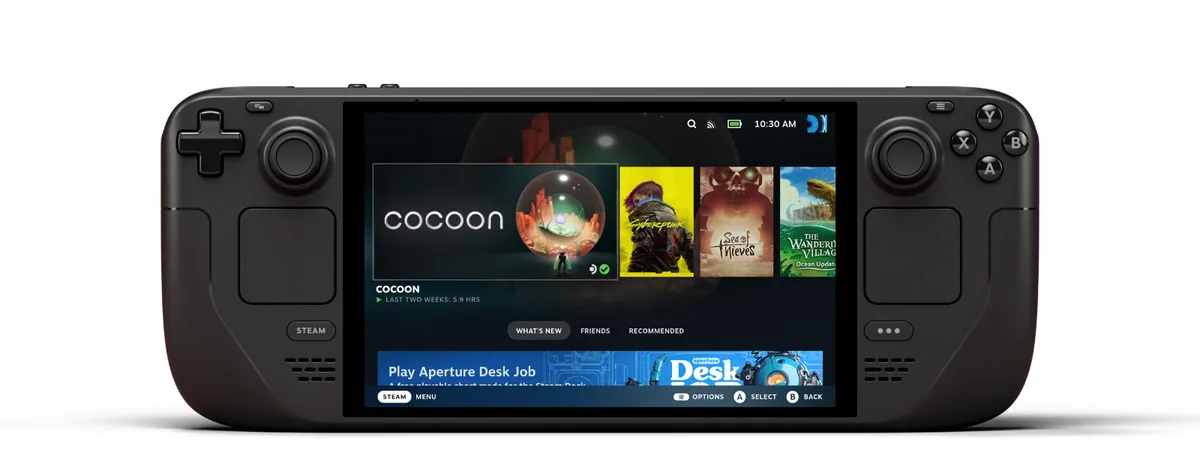
The Deck OLED has a 7.4-inch 1280 by 800 HDR OLED display up to 90Hz and a 50Wh battery.
The rest of the industry is now solving the same problem
Microsoft and ASUS launched the ROG Xbox Ally family around an Xbox-oriented mode designed specifically to make Windows handheld gaming feel less like using a desktop on a tiny screen.
Microsoft's current product page emphasizes an Xbox mode, consolidated game library, Game Bar access and handheld compatibility labeling.
Those are software-experience features.
They are not GPU specifications.
That is telling.
The same thing happened on the other side of the ecosystem. Valve officially expanded SteamOS beyond Steam Deck through Lenovo's Legion Go S, describing it as the first third-party handheld licensed to ship with SteamOS. Valve has continued broadening device support since then.
In other words, the handheld-PC competition is slowly becoming a competition over which operating environment best hides the PC.
Raw performance still matters
It would be silly to pretend otherwise.
A faster handheld can hold higher frame rates, increase resolution, use heavier visual settings and run newer games that strain the Deck.
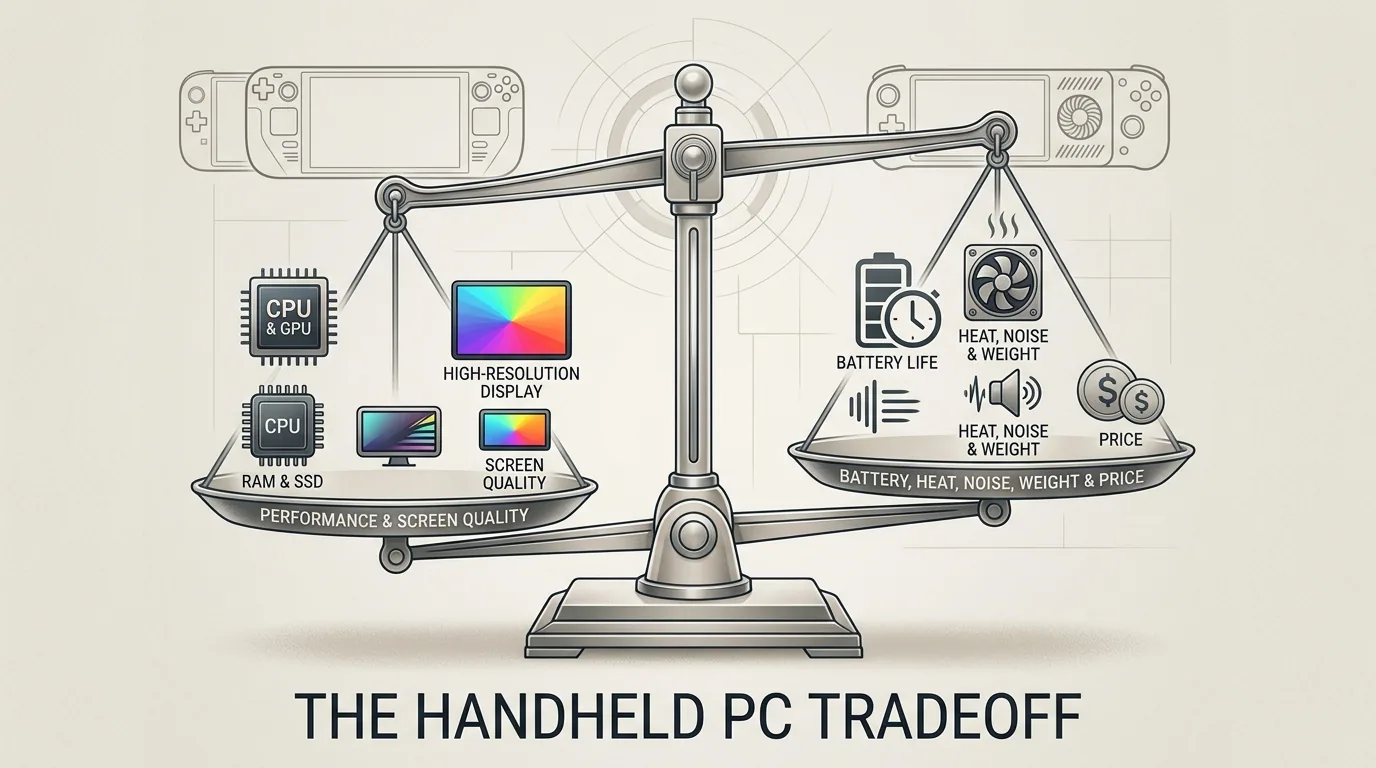
The challenge is power.
A desktop GPU can consume hundreds of watts because it sits in a box connected to the wall.
A handheld has a battery measured in watt-hours, a small cooling system and a surface that somebody must comfortably hold.
Push the processor harder and you consume more energy.
More energy creates heat.
More heat demands cooling.
Cooling creates noise and weight.
Larger batteries add more weight again.
Handheld design is a negotiation rather than an arms race.
The Deck's original hardware was conservative enough that Valve could tune software and game profiles around a predictable target.
Prices are moving in the opposite direction from the original dream
The newest handheld hardware is also exposing a market problem.
ASUS's newly announced OLED Xbox Ally X20 begins around $1,300, while a premium bundle reaches far higher. Other enthusiast handhelds have moved into laptop-level pricing.
At those prices, the meaning of "portable gaming PC" changes.
A buyer is no longer choosing between a handheld and a console.
They may be choosing between a handheld and an excellent gaming laptop, desktop upgrade, console plus games or several years of Steam purchases.
Premium devices can absolutely justify themselves to enthusiasts.
The risk is turning a category that felt wonderfully democratic when Steam Deck arrived into another luxury-PC niche.
Compatibility remains SteamOS's biggest compromise
Valve's console-like experience is not free.
SteamOS is Linux-based, and Proton translates the behavior expected by many Windows games.
The results can be remarkably good, but not universal.
Some games using anti-cheat or unusual middleware still do not work properly.
Some launchers behave awkwardly.
Competitive multiplayer games can be a particular problem.
Windows handhelds avoid much of this because they run the environment PC games are normally built for.
That freedom comes at the cost of carrying Windows itself.
There is no perfect answer.
SteamOS prioritizes appliance-like behavior and accepts compatibility exceptions.
Windows prioritizes compatibility and asks the interface to adapt.
The fact that both Valve and Microsoft are investing heavily in this layer tells us where the real handheld battle is happening.
The Deck's greatest achievement may be SteamOS escaping the Deck
A hardware company normally wants its operating system to sell its own hardware.
Valve has a different incentive.
Valve makes money when people buy games on Steam.
If SteamOS runs well on Lenovo, ASUS and other handhelds, Valve benefits even when the customer never purchases a Steam Deck.
That could make SteamOS more important than the Deck itself.
The handheld becomes the reference design.
The operating system becomes the platform.
Valve's recent SteamOS updates already mention controller, power and hardware support for a growing list of third-party handhelds.
That is a much larger ambition than selling one portable PC.
So should you still buy a Steam Deck in 2026?
The answer depends on what you want the handheld to be.
If maximum performance in new AAA games is the priority, newer hardware is increasingly attractive.
If Game Pass, unsupported anti-cheat titles and the widest possible Windows compatibility matter, a Windows device may make more sense.
If you want a mature portable Steam machine that behaves predictably, the Deck remains compelling despite its age.
This is why specifications alone have repeatedly failed to kill it.
Valve did not merely build a small gaming computer.
It identified the point where a general-purpose computer becomes inconvenient enough that users begin craving an appliance again.
Every new handheld with a simplified launcher, console-like mode, compatibility badge, suspend feature or controller-first UI is evidence that the lesson landed.
The Steam Deck is getting older.
Its idea is not.