
Why Is Every New PC Game 100GB Now? The Real Reason Install Sizes Exploded
Why are modern games 100GB, 150GB or even larger? Textures are only part of the answer. Audio, duplication, compression and streaming all matter.
There was a time when a 1TB drive felt almost comically spacious.
Today you can install a handful of major games, forget about storage for a few months, and discover that Windows is warning you about free space.
Modern game installs routinely pass 100GB. Some grow far beyond that after expansions, language packs and high-resolution assets are included. The usual explanation is "graphics got better," which is correct in roughly the same way that saying "airplanes fly because of wings" is correct. It leaves almost everything interesting unexplained.
The real story involves textures, audio, geometry, compression, duplicated data, patching strategies and the way modern games stream enormous worlds while you move through them.
High-resolution textures become enormous very quickly
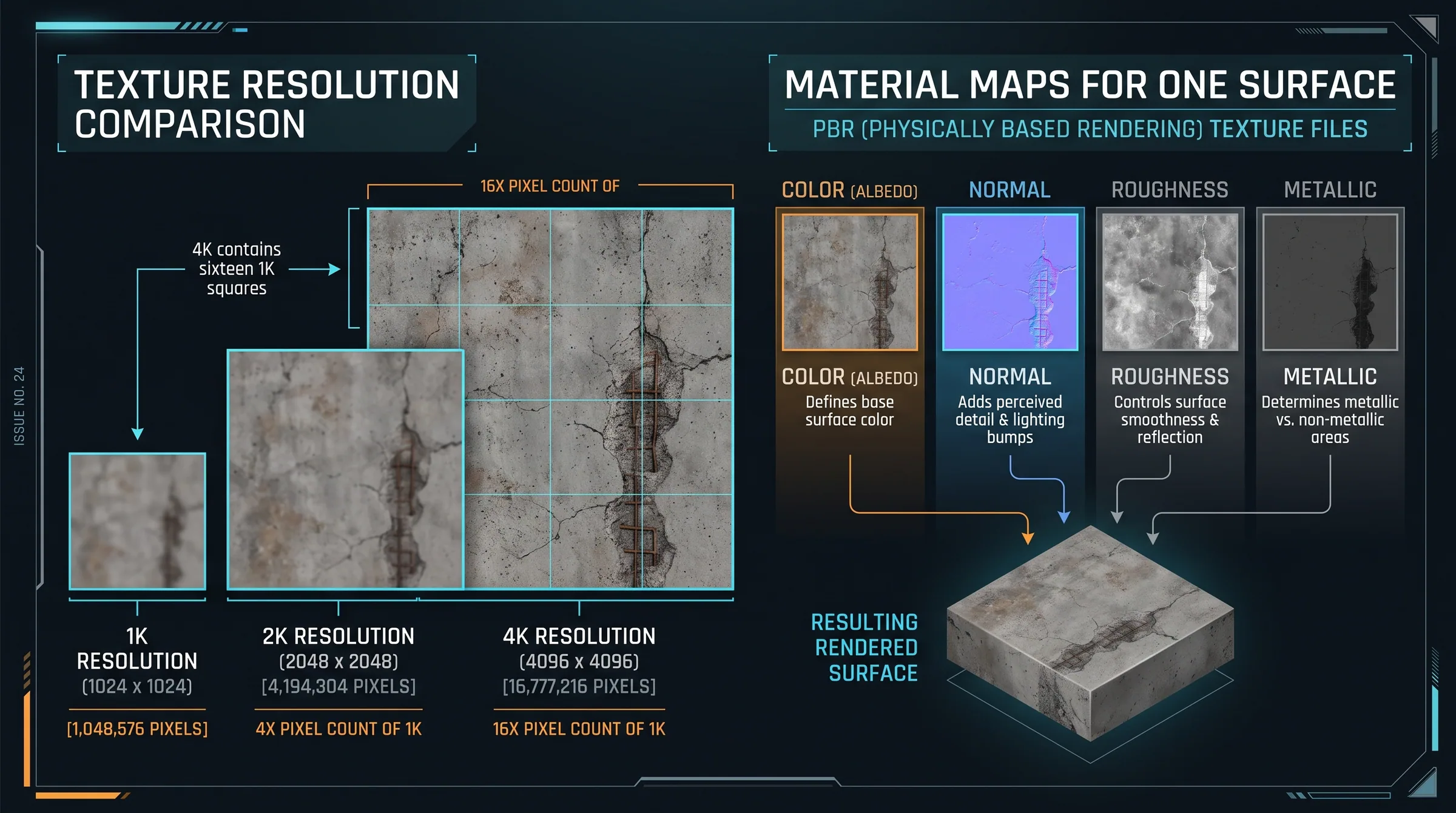
Texture size grows with area rather than linearly.
Double an image from 2048 by 2048 pixels to 4096 by 4096 and you have not doubled the number of pixels.
You have quadrupled it.
Modern games also rarely use one texture per object. A surface might use separate maps describing color, normals, roughness, metallic properties, ambient occlusion and other material characteristics.
That means the beautiful brick wall you barely notice while sprinting through an alley may require several high-resolution data sets.
PC Gamer once demonstrated the scale of this problem by estimating that thousands of 4K textures can consume hundreds of gigabytes before accounting for audio, geometry, video or other assets. Compression reduces those numbers dramatically, but it cannot make high-resolution artwork free.
Modern worlds contain more unique things
Resolution is only half of the texture story.
Older games reused assets aggressively.
A hallway might repeat the same wall texture every few meters. Several buildings could share one door. Different characters might use recolored versions of the same clothing.
Modern players notice repetition much faster because visual expectations increased.
Open-world environments are expected to contain enormous numbers of unique storefronts, signs, vehicles, props, interiors, clothing pieces, foliage types and surface variations.
Even when individual files are compressed efficiently, the number of files becomes overwhelming.
This is one reason modern games can look less obviously repetitive than older ones while consuming dramatically more storage.
We bought variety with disk space.
Audio is a quiet storage monster
Graphics receive most of the blame because textures are easy to visualize.
Audio can be enormous.
A modern cinematic game may contain tens of thousands of spoken lines performed by large casts. If several languages are installed simultaneously, dialogue storage multiplies.
Then add music, ambience, weapon sounds, environmental recordings, vehicle audio and cinematics.
Audio compression helps, but developers also balance file size against CPU cost and quality. Intel notes that some games have historically stored certain assets with lighter compression or uncompressed formats because decompression itself consumes processing resources.
This trade-off matters because game data is not an archive sitting quietly on your drive.
The engine must access it quickly while you play.
Storage speed changed what developers can assume
Hard-drive-era games were designed around slow seek times.
Developers sometimes duplicated commonly needed data in multiple physical locations on a disc or drive so the storage head did not have to travel as far to retrieve it.
Modern SSDs remove much of that mechanical limitation.
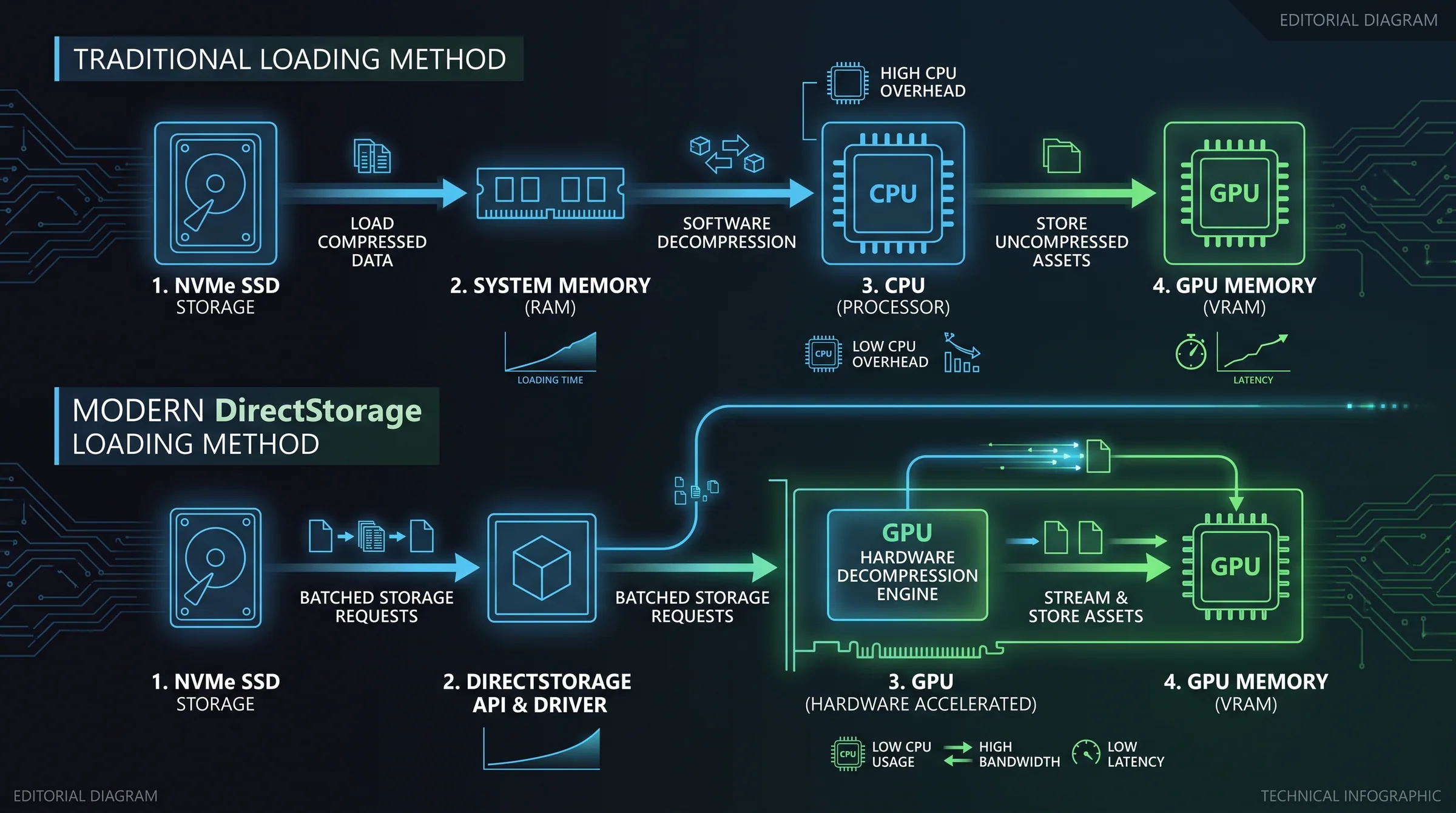
More importantly, NVMe drives can process enormous numbers of requests quickly, which has encouraged a different style of asset streaming.
Microsoft created DirectStorage specifically to reduce the overhead involved when games request huge numbers of small data blocks and to move compressed assets through the storage pipeline more efficiently. DirectStorage 1.1 added GPU decompression, allowing suitable workloads to be decompressed by the graphics processor rather than consuming CPU time.
In 2026, Microsoft is still expanding DirectStorage with new compression and asset-conditioning work intended to improve large-scale streaming.
Compression creates a three-way argument between size, speed and quality
Why not compress every game down aggressively before shipping?
Because compression is not free.
More aggressive compression may require more processing when assets are needed.
Lossy compression can reduce quality.
Some formats work well for storage but poorly for real-time GPU access.
Developers therefore choose formats according to the asset and how frequently it needs to be streamed.
This is part of why installing a game is not the same problem as compressing a folder into a ZIP archive.
A ZIP file can spend seconds decompressing before you use its contents.
A game streaming an open world may need the next texture almost immediately because you just drove around a corner at 150 mph.
Why doesn't better compression make games smaller every year?
It does help.
The problem is that asset ambition grows at the same time.
Imagine compression improves enough to make a texture 30 percent smaller.
Artists then use the saved budget to add more textures, increase resolution, improve material complexity or build a larger environment.
Technology rarely produces permanently smaller games because developers spend the savings.
This pattern exists throughout computing.
Processors become faster, so software attempts more work.
GPUs become faster, so rendering becomes more complicated.
Storage grows, so games contain more assets.
Bandwidth improves, so worlds become denser.
The limit moves and developers chase it.
Cinematics can add surprising amounts of data
Pre-rendered video remains useful because it guarantees exact presentation regardless of what is happening in the real-time renderer.
High-resolution, high-bitrate cinematic files are not small.
A game containing hours of 4K video can devote tens of gigabytes to sequences that players may watch once.
Some studios render cutscenes in-engine to avoid this storage cost and improve continuity with gameplay.
Others use video because it offers predictable quality, particularly for complex scenes.
Again, there is no universal reason behind large game sizes. Different games arrive at 100GB through different combinations of assets.
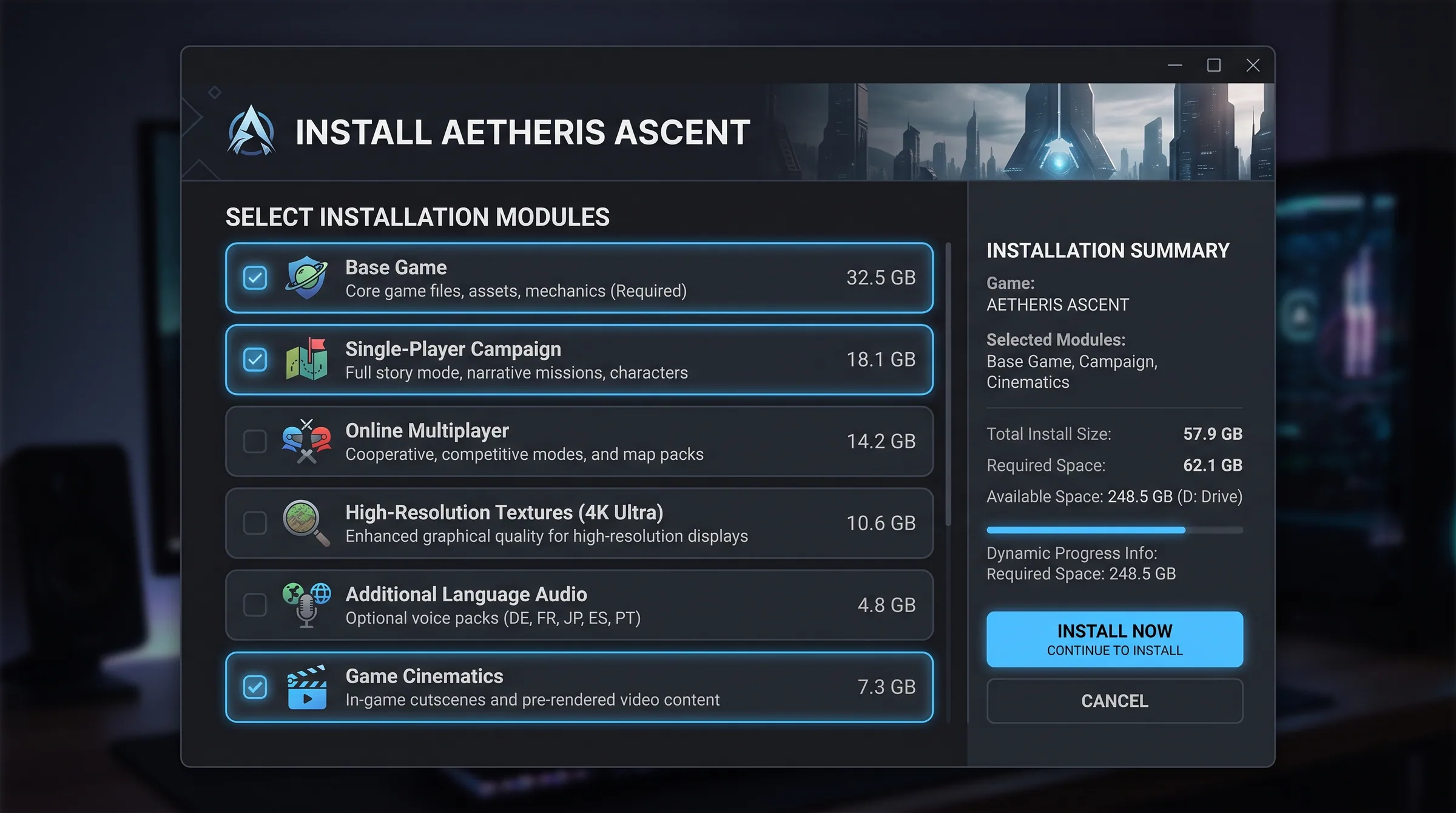
Why can't I install only the parts I need?
This is one area where publishers could improve the situation substantially.
There is no technical law requiring campaign data, multiplayer maps, every language pack and ultra-resolution textures to live in one indivisible installation.
Some games already let players remove portions of the package.
That approach deserves to become normal.
A player using a 1080p display may not need an enormous 4K texture pack.
Someone who finished the campaign might want to retain multiplayer without storing every story cinematic.
Language audio could be optional.
Modular installs do not solve the underlying growth of game assets, but they stop every user from paying the maximum storage price.
DirectStorage will not magically make 150GB become 50GB
This misconception appears whenever storage technology improves.
DirectStorage is primarily about moving and decompressing data efficiently.
Better compression support can help developers store assets more economically, but the technology's larger purpose is enabling games to stream huge quantities of data fast enough for modern worlds.
In some cases, that could even encourage developers to use more detailed assets because the storage pipeline can finally keep up.
Faster storage does not necessarily shrink games.
Sometimes it gives games permission to become even larger.
The uncomfortable truth is that 100GB games are not an accident
Developers did not collectively forget how to compress files.
We asked for enormous worlds with unique environments, detailed faces, high-resolution surfaces, fully voiced dialogue, cinematic storytelling, elaborate audio and almost no loading screens.
Storage is one of the places where those expectations become visible.
That does not excuse wasteful packaging. Some games are clearly better managed than others, and publishers should give players more control over optional data.
But the broad trend is unlikely to reverse.
The real question for the next decade is not whether games return to 20GB.
It is whether smarter streaming, neural compression, modular installations and better asset pipelines can stop visual ambition from turning every SSD into a temporary rental property for three games.