
Windows 10 Gamers Have About Two Months Before Nvidia Moves On. Should You Finally Upgrade?
Nvidia's final Windows 10 Game Ready driver arrives in October 2026. Here is what changes, what keeps working, and whether gamers should move to Windows 11.
Windows 10 is turning into the operating system nobody can quite convince millions of PC users to leave.
Microsoft ended ordinary Windows 10 support on October 14, 2025, although Extended Security Updates have allowed enrolled machines to continue receiving important security fixes. Gamers, meanwhile, received an extra reprieve from Nvidia. The company promised one additional year of normal GeForce driver support after Microsoft's deadline.
That extra year is almost over.
Nvidia says its final Game Ready Driver supporting Windows 10 will arrive in October 2026. Beginning in November, new Game Ready releases will no longer support the operating system. Nvidia plans to continue quarterly critical security updates for Windows 10 through October 2029, but that is not the same thing as full game-oriented driver support.
If you have been postponing Windows 11 specifically because your gaming PC still works perfectly on Windows 10, this is the first deadline that meaningfully changes the calculation.
Your graphics card will not stop working in November
This needs to be stated clearly because "support ends" often gets translated online into something much more dramatic.
Your RTX or GTX card will not switch itself off.
Installed games will not suddenly refuse to launch simply because November begins.
Your existing Nvidia driver will remain installed, and older games that already run correctly should generally continue behaving as they did before.
What changes is future support.
Game Ready drivers are where Nvidia delivers optimizations, compatibility work and bug fixes for new game releases. Nvidia describes these drivers as being tested specifically for major game launches and updates.
After Windows 10 leaves that branch, a new game released in 2027 could receive fixes and optimizations in a Windows 11 driver that never reaches your Windows 10 installation.
That distinction becomes increasingly important over time.
Windows 10 is still surprisingly common among Steam players
If Nvidia were abandoning a tiny group of hobbyists, the decision would be less interesting.
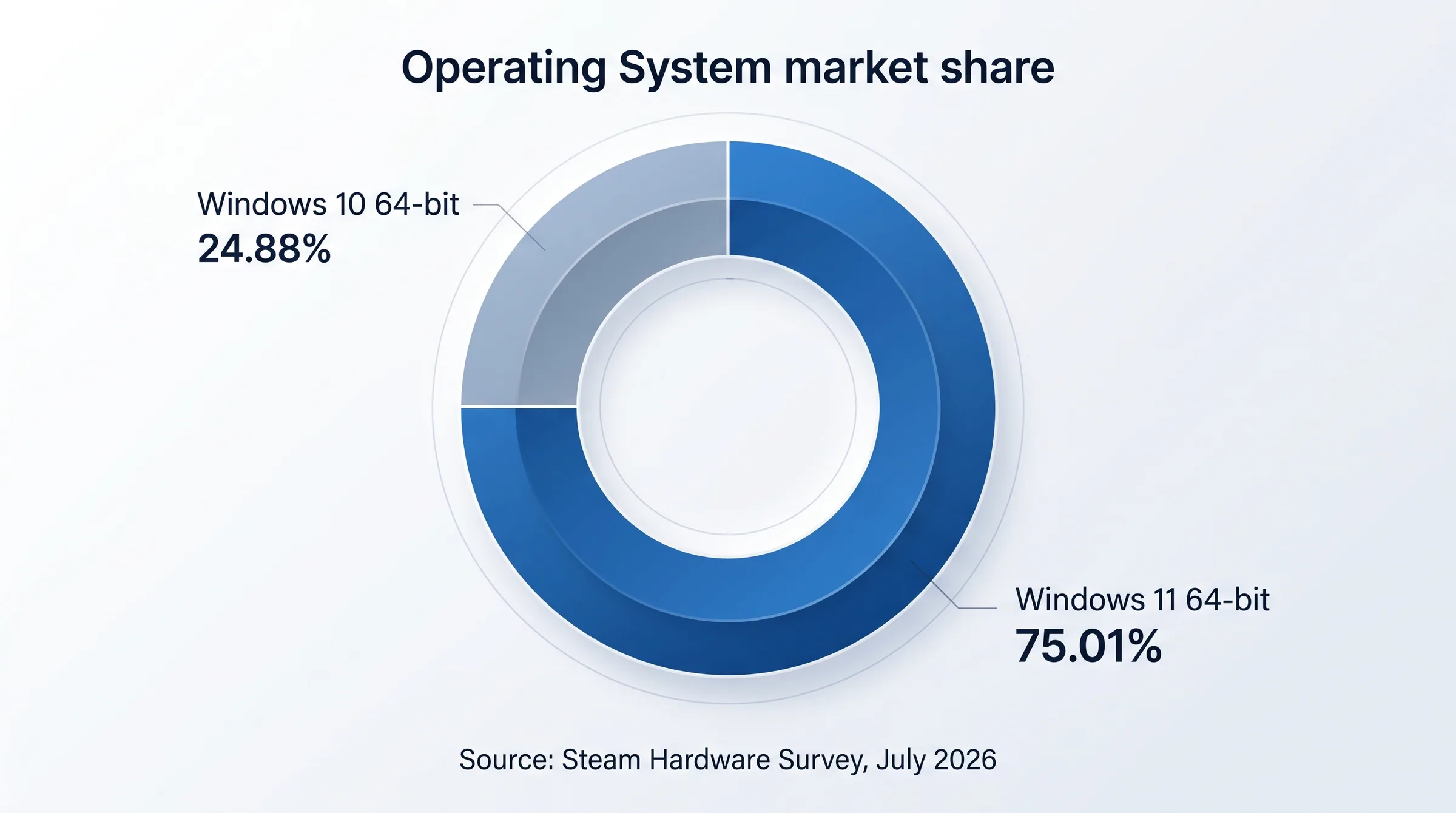
Steam's July 2026 hardware survey reported Windows 11 at roughly 75 percent of surveyed Windows PCs, but Windows 10 still accounted for almost a quarter.
A quarter of Steam's Windows population is not trivial.
It explains why Nvidia extended full support for an extra year after Microsoft's original end date. It also explains why the company is continuing security maintenance through 2029 rather than simply walking away.
The transition is happening.
It just isn't complete.
Why gamers stayed on Windows 10 for so long
Some people simply dislike Windows 11's interface changes.
Others own hardware that does not meet Microsoft's official requirements.
Some depend on old software or peripherals.
Many gamers follow an even simpler rule: never change a working gaming PC unless you have a reason.
That instinct is not irrational.
Operating-system upgrades can introduce driver issues, changed settings, new background features or unexpected compatibility problems. Anyone who has maintained a Windows gaming machine for twenty years has learned that "new" does not automatically mean "better for me."
The difference in 2026 is that remaining on Windows 10 increasingly requires active maintenance of an old environment rather than simply declining an optional upgrade.
Microsoft's free mainstream support has already ended.
Nvidia's full Game Ready support is next.
Eventually game developers will begin dropping Windows 10 from their own support lists as the audience becomes smaller.
Does Windows 11 actually hurt gaming performance?
This fear lingered for years because Windows 11 had genuine teething problems early in its life.
Today, the question is much less dramatic.
For a modern supported gaming PC with updated drivers, there is no universal rule that Windows 11 meaningfully destroys gaming performance. Differences depend on hardware, game, security settings and software configuration.
The more practical argument now concerns features and future support rather than a mythical permanent frame-rate penalty.
Windows 11 is the platform where Microsoft is focusing newer gaming technologies and operating-system changes. DirectStorage, modern display features, scheduler improvements and future driver work increasingly assume that Windows 11 is the normal Windows gaming environment.
Microsoft's own DirectStorage documentation has long noted that while compatible games can benefit on Windows 10, Windows 11 includes newer storage-stack optimizations designed with DirectStorage in mind.
What if your PC officially cannot run Windows 11?
This is where the advice becomes less convenient.
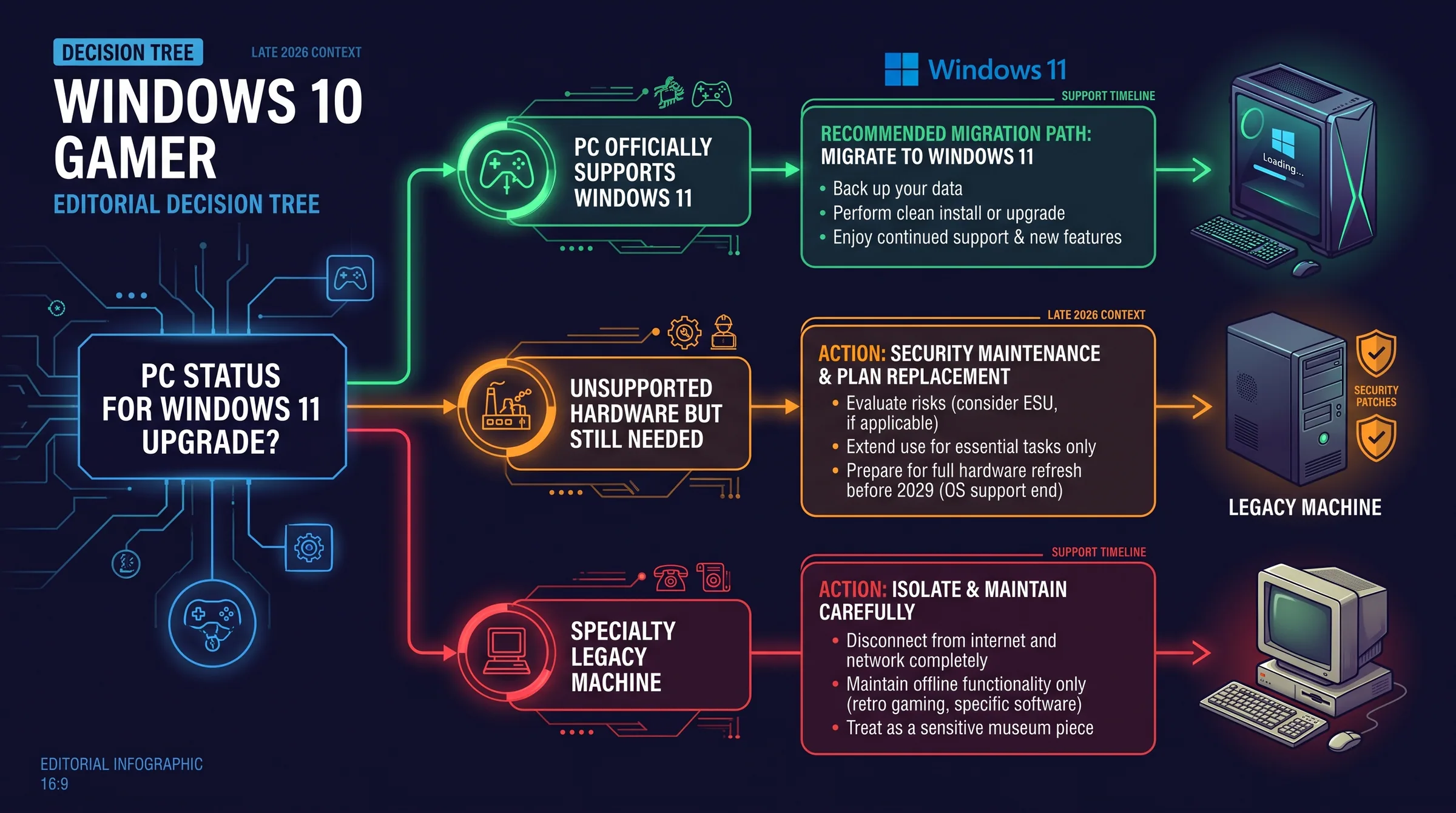
Many perfectly capable gaming PCs use CPUs Microsoft does not officially support for Windows 11 or lack the expected TPM configuration.
There are unofficial methods of installing Windows 11 on unsupported machines, but doing so puts the user outside the cleanest supported path. For a machine containing important personal data, that is a decision worth treating more seriously than a gaming tweak.
The alternative is to remain on Windows 10 with the understanding that you are entering a maintenance period.
Microsoft's Extended Security Updates can address the operating system's security side for eligible enrolled machines. Nvidia's quarterly Windows 10 updates continue addressing critical GPU-driver security issues through October 2029.
Neither provides the same long-term environment as a supported Windows 11 installation.
If your PC supports Windows 11, the argument for staying is getting weaker
A year ago, a gamer could reasonably say: Windows 10 still works, Nvidia still supports it, my games still run, so why touch anything?
After October, one of those statements changes.
That does not require an emergency upgrade tonight. It does mean the upgrade should move from "someday" to "before I begin depending on new games and new driver fixes."
The cleanest strategy is to migrate when you have time to do it properly rather than waiting for a new release to force your hand.
Back up important data.
Check motherboard BIOS and TPM settings.
Update firmware.
Make sure critical peripherals and software support Windows 11.
Then move while the Windows 10 installation is still healthy.
The important deadline is not Microsoft's anymore
For gamers, October 2026 may ultimately feel more consequential than October 2025.
Microsoft ending mainstream support was a security and platform-management event.
Nvidia ending Game Ready support affects something gamers notice directly: new games.
A future title may launch with a driver specifically designed to fix crashes, optimize shader behavior or correct rendering problems.
Windows 11 gets it.
Windows 10 does not.
At first, that gap may be invisible.
Then one game behaves strangely.
Then another requires a newer branch.
Then a launcher updates.
Then an anti-cheat system changes.
Old operating systems usually do not die from one catastrophic incompatibility.
They become inconvenient a piece at a time.
Windows 10 has reached that stage.
If you own a modern gaming PC that officially supports Windows 11, October is probably the point where stubbornness stops buying you much.