
720Hz OLED Is Here. Have Gaming Monitors Finally Gone Too Far?
ASUS just announced a 720Hz OLED gaming monitor. Does 720Hz actually matter, can humans see it, and what do you gain over 240Hz or 360Hz?
Somewhere between the arrival of 240Hz monitors and the moment manufacturers began discussing 500Hz displays, gaming hardware entered a phase where every new refresh-rate number sounded increasingly like satire.
Now we have reached 720Hz OLED.
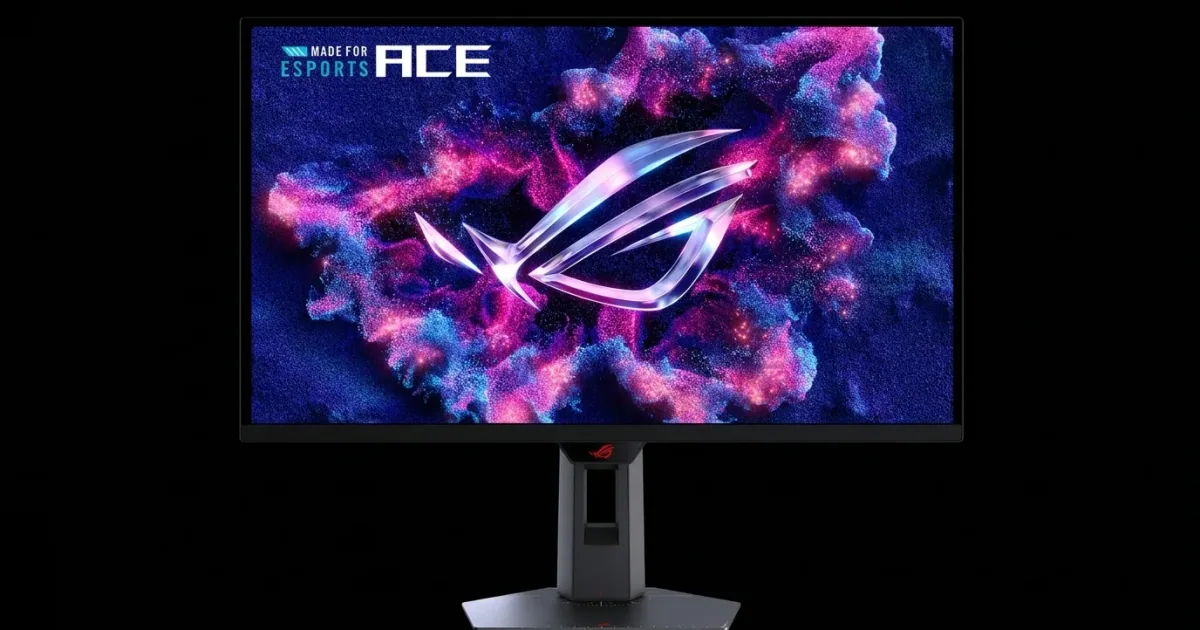
ASUS announced the 24.5-inch ROG Swift OLED PG259QWS Ace at Gamescom 2026 with a 1920 by 1080 tandem-WOLED panel, a 720Hz maximum refresh rate and quoted 0.02 ms pixel response. The company says it will sell for $1,099 and, more interestingly, the monitor has been selected as the official display for the PGL Counter-Strike 2 Major in Singapore later this year.
This is therefore not merely a laboratory panel built so somebody could put a giant number on a convention banner.
Professional players are about to use it.
The obvious question is whether 720Hz provides anything a human being can actually perceive, or whether gaming displays have finally crossed into specification theater.
Start by converting Hertz into something your brain can understand
Refresh rate tells you how frequently the monitor can begin displaying a new image.
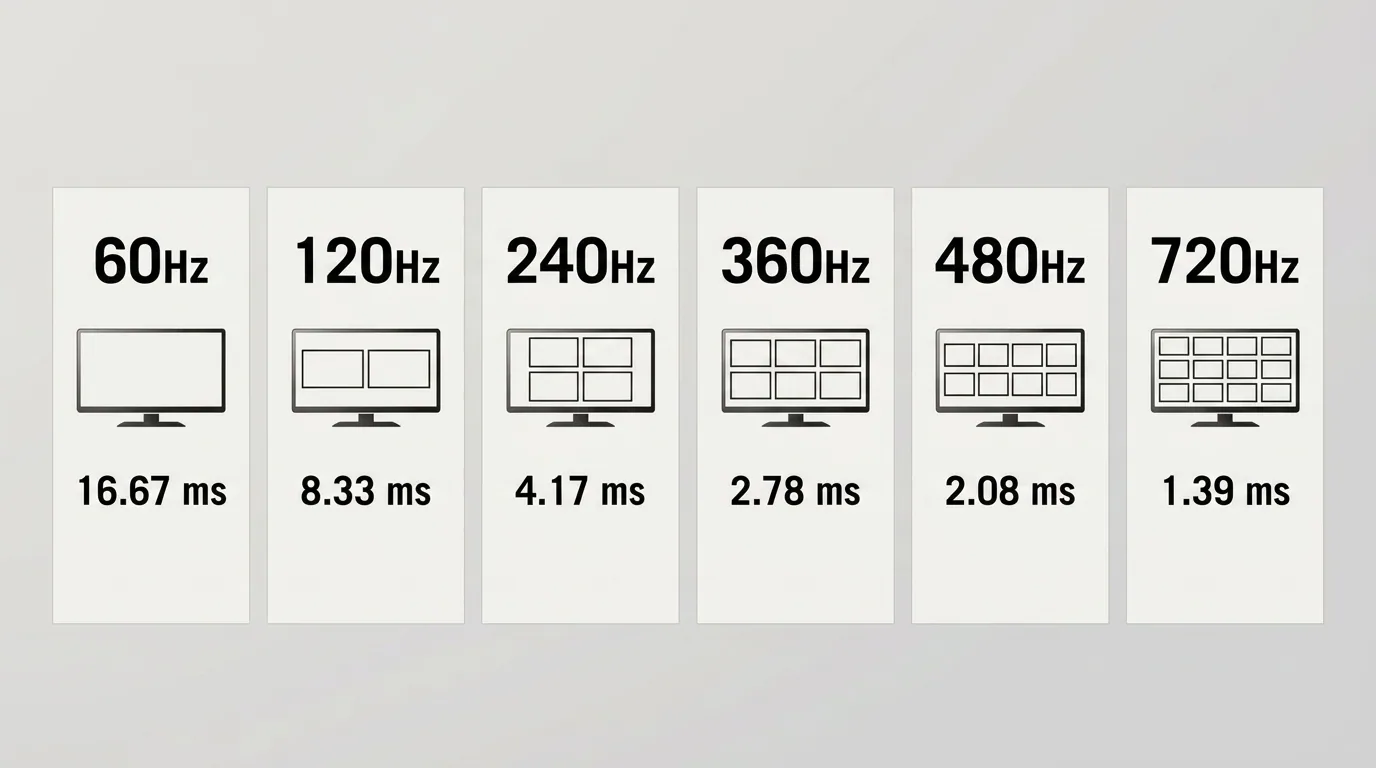
At 60Hz, each refresh interval lasts about 16.67 milliseconds.
At 120Hz, about 8.33 ms.
At 240Hz, about 4.17 ms.
At 360Hz, about 2.78 ms.
At 480Hz, about 2.08 ms.
At 720Hz, about 1.39 ms.
That immediately explains both sides of the argument.
Going from 60Hz to 120Hz removes more than eight milliseconds from the refresh interval.
Going from 360Hz to 720Hz removes only about 1.39 milliseconds.
The benefits are real.
The returns are clearly diminishing.
Why higher refresh still improves motion after 240Hz
A common internet claim says that humans cannot see beyond some fixed frame rate.
That is not how visual perception works.
Your eye does not contain a 60Hz video decoder.
Different visual phenomena have different thresholds, and high-refresh displays improve more than the ability to consciously count individual frames.
Motion clarity is one important example.
Modern LCD and OLED monitors are generally sample-and-hold displays. A frame remains visible for most or all of its refresh interval while your eyes continue moving to track objects.
That creates perceived blur during eye tracking even when the panel's pixel transitions are extremely fast.
Shorten the duration for which each frame remains visible and the tracked image can appear clearer.
Display-testing specialists at Blur Busters describe this relationship as the reason doubling frame rate and refresh rate can approximately halve sample-and-hold motion blur when pixel response is sufficiently fast.
OLED is particularly well suited to demonstrating the effect because its pixel transitions are already extremely quick.
720Hz makes far more sense for Counter-Strike than for Cyberpunk
The first problem with a 720Hz monitor is obvious.
You need frames.
Lots of them.
A cinematic AAA game using heavy ray tracing might run at 80, 120 or 180 fps on a powerful PC.
A 720Hz display can still operate at lower frame rates, but the reason to buy it is severely weakened if your game cannot approach its refresh range.
Counter-Strike 2 is different.
Competitive players deliberately use low resolutions and optimized graphics settings to achieve extraordinarily high frame rates.
A top-end esports PC can produce several hundred frames per second in the right conditions.
This is why ASUS designed the panel at 1080p and 24.5 inches rather than 4K at 32 inches.
Resolution is not the priority.
Temporal precision is.
Does 720Hz lower input lag?
Potentially, yes, although refresh rate is only one part of total system latency.
If a completed frame arrives just after a slower monitor began its current refresh, it may wait longer before presentation.
A higher-refresh display provides more frequent opportunities to show new information.
At 720Hz, those opportunities occur every 1.39 milliseconds.
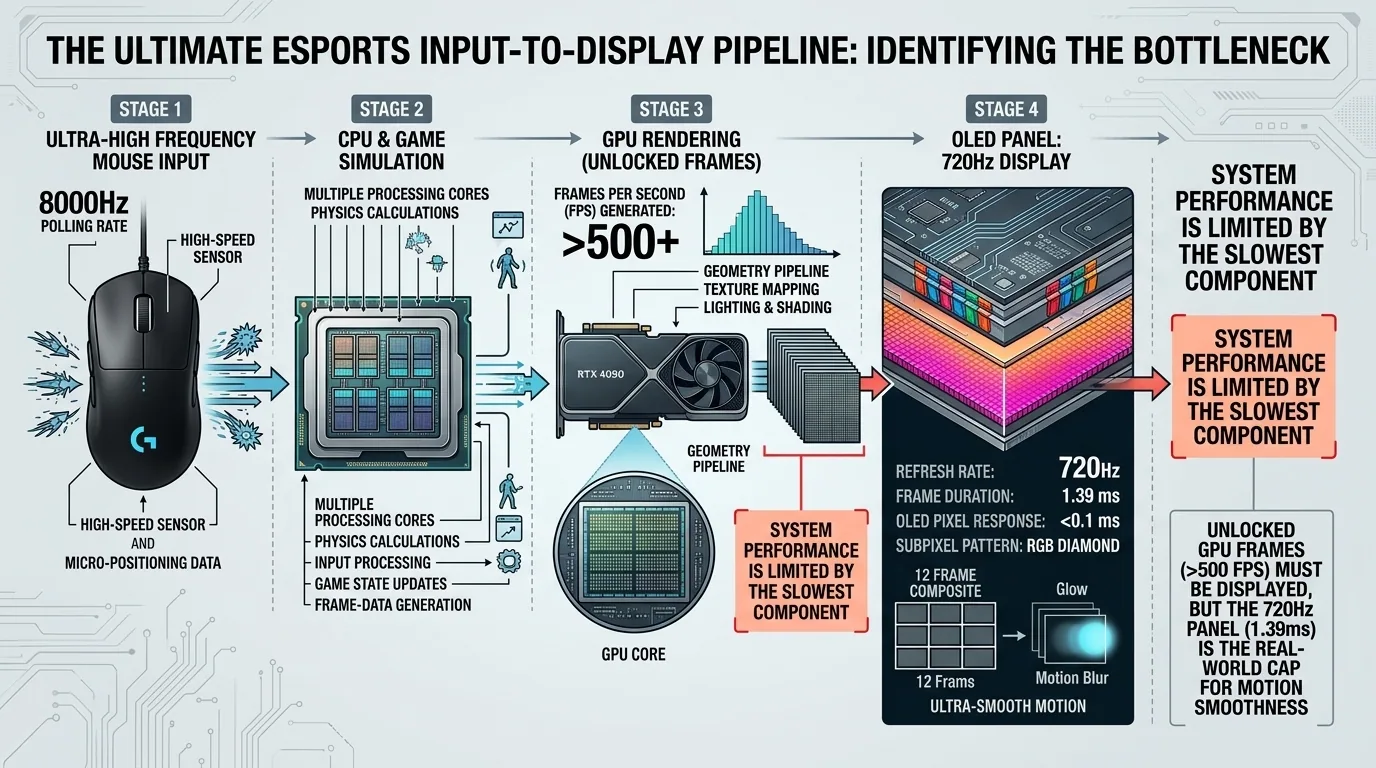
But your mouse, game engine, CPU, GPU render queue and display pipeline all contribute latency.
A 720Hz monitor connected to a game producing 90 fps does not magically create 720 fps responsiveness.
This is why the entire system matters, which is exactly the subject we explored in What Is Input Lag and Can You Actually Notice It?
The OLED part may matter as much as the 720Hz part
Fast LCD esports displays have existed for years, often using TN panels because those panels could reach extreme refresh rates with excellent response.
They also came with obvious compromises in image quality.
OLED changes the trade.
ASUS is advertising very fast response alongside perfect-looking blacks, strong HDR capability and high peak brightness on its new tandem-WOLED panel.
If OLED can sustain esports-class refresh rates while offering dramatically better contrast and color than traditional TN displays, the larger historical story may not be that monitors reached 720Hz.
It may be that competitive players no longer need an ugly monitor to get the fastest one.
The PGL adoption is significant for exactly that reason.
Would an ordinary player notice 240Hz versus 720Hz?
Some will.
Many probably will not care enough to pay $1,099.
The difference becomes easiest to notice with very fast motion, high game frame rates and tasks where the eye tracks small moving objects precisely.
A competitive Counter-Strike player performing rapid flicks has a much better use case than someone playing Civilization.
This is also why asking "Can humans see 720Hz?" is the wrong question.
A more useful question is:
Can a particular player perform or perceive a meaningful improvement in a particular workload when moving from their current display to 720Hz?
For someone upgrading from 60Hz, virtually everything about the transition will feel enormous.
From 144Hz, the improvement is smaller but still substantial.
From 240Hz to 360Hz, it becomes much more specialized.
From 480Hz to 720Hz, we are deep into enthusiast and esports territory.
The technology is not imaginary merely because the audience becomes smaller.
There is also a mouse problem nobody mentions
A 720Hz monitor updates roughly every 1.39 milliseconds.
If your mouse is polling slowly enough, the display can begin updating more frequently than the input device is providing fresh positional data.
This is one reason very high polling-rate gaming mice exist.
At ordinary refresh rates, an 8,000Hz mouse can seem absurd.
At 720Hz, the relationship becomes easier to understand.
Building a genuinely low-latency high-refresh system requires the entire chain to operate quickly.
CPU.
Mouse.
Game.
GPU.
Display.
The monitor cannot compensate for a bottleneck earlier in the path.
Is 720Hz ridiculous?
Yes.
And no.
It is ridiculous for most people in exactly the same way a 1,000-horsepower road car is ridiculous for most people.
You do not need it to travel to work.
That does not mean the engineering has no purpose.
Extreme products expose limitations that later improvements can address at lower prices.
Today's absurd 720Hz OLED may contribute to tomorrow's ordinary 360Hz OLED becoming cheaper, brighter, more durable and widely available.
The interesting thing is not that every gamer should buy one.
They should not.
It is that display technology has reached a point where an OLED panel can refresh every 1.39 milliseconds and professional Counter-Strike organizers consider it mature enough for a Major tournament.
Twenty years ago, gamers argued about whether LCDs were finally fast enough to replace CRTs.
Now we are debating whether 720 refreshes per second are excessive.
That is a much nicer problem to have.