
Couch Co-Op Didn't Die Because Nobody Wanted It. So What Happened?
Split-screen multiplayer once seemed standard. Then major games quietly dropped it. Here's why couch multiplayer became harder to find.
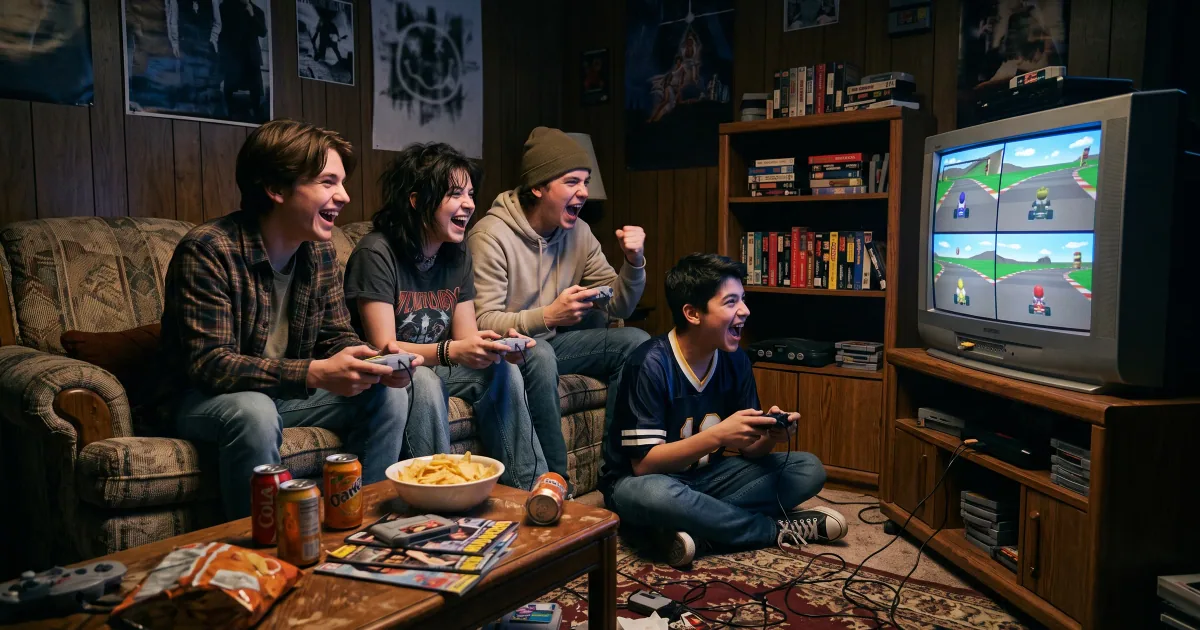
For a long time, multiplayer had a simple physical meaning.
Other players were in the room.
They sat beside you on the carpet or squeezed onto the same sofa. Somebody brought another controller. The television was divided into two or four increasingly tiny rectangles, everyone claimed they were not looking at anybody else's part of the screen, and eventually somebody accused everybody else of cheating anyway.
Split-screen multiplayer was not a niche feature. On many console games it was simply part of what multiplayer meant.
Then something changed.
Online multiplayer became dominant, televisions became larger, consoles became dramatically more powerful—and somehow the feature that should have benefited from all of that hardware became less common.
It is tempting to conclude that publishers simply stopped caring about local multiplayer.
The reality is more complicated.
Split-screen makes a console do the expensive part more than once
A modern game may already push a console close to its limits while rendering one player's view.
Now add another camera.
The second player may be standing somewhere completely different, looking in another direction. The game potentially needs to determine what is visible from that camera, process its effects and render another version of the scene.
Four-player split screen can mean four independent views.
Not every part of the workload multiplies by four, but plenty of expensive work increases significantly.
Older games dealt with the same fundamental problem, but their scenes were simpler and developers were more willing to reduce visual quality dramatically in multiplayer.
Modern audiences expect dense environments, advanced lighting, high-resolution effects, detailed characters and stable frame rates. Maintaining those standards while rendering several views becomes difficult quickly.
This explains the strange irony: more powerful hardware did not automatically make split screen free, because games became more demanding at the same time.
Online play solved the rendering problem elegantly
Imagine four people playing the same game online.
Each console renders only one player's view.
The machines exchange information about what players are doing, but every player brings their own display and hardware.
From a rendering perspective, this is wonderful.
From the publisher's perspective, it can be attractive for other reasons too.
Each person may need their own console.
Their own copy of the game.
Possibly their own online subscription.
A group playing on one television needs considerably less hardware.
It would be too simplistic to argue that couch co-op disappeared purely because companies wanted to sell four copies instead of one, but the commercial incentives certainly stopped favoring local play as strongly as they once had.
Game design itself moved online
Once broadband connectivity became normal, developers began building games around assumptions that made less sense on one television.
Large multiplayer lobbies.
Persistent online profiles.
Skill-based matchmaking.
Voice chat.
Enormous maps designed for players located far apart.
Competitive ranking.
Live-service progression.
The very shape of multiplayer changed.
A four-player GoldenEye match could be understood as four people sharing an arena.
A modern 100-player battle royale cannot simply be translated into four rectangles on a television without reconsidering most of the experience.
Local multiplayer went from being the default format to being one possible mode among many.
Screens got bigger—but interfaces became more complicated
This seems contradictory.
A modern 65-inch television should be fantastic for four-player split screen compared with a tiny CRT.
Physically, yes.
But modern interfaces contain vastly more information.
Mini-maps, inventories, quest markers, ammunition counters, ability cooldowns, text chat, subtitles and objective information all compete for screen space.
Shrink the viewport to one quarter and the game may become difficult to read even on a huge display.
Designers have to build alternative UI layouts specifically for split-screen play.
That means additional development work for a mode that may represent only part of the audience.
Testing becomes much harder too
Adding split screen is not simply a checkbox labelled "two players."
What happens when one player opens a menu while the other is fighting?
Can both open inventories simultaneously?
What happens during a cutscene?
Can one player trigger a mission transition while the other is somewhere else?
How does audio work when two players are near different sound sources?
Can the game stream two different areas of the world at once?
Does performance collapse when both players enter demanding scenes?
Every feature creates combinations that need to be designed and tested.
For a development team already trying to ship an enormous game, local multiplayer becomes surprisingly expensive.
But couch multiplayer never actually disappeared
This is the part often lost in discussions about the "death" of split screen.
Local multiplayer survived exceptionally well in genres where physical presence improves the experience.
Fighting games still expect two people to share a machine.
Sports games remain natural couch experiences.
Party games thrive on the social chaos of everybody occupying the same room.
Indie games have produced a long line of excellent local cooperative experiences precisely because they can design around shared play from the beginning.
Nintendo in particular has continued treating local multiplayer as a major part of console identity.
The feature did not die.
It became selective.
And people discovered that being in the same room is actually different
Online play solves distance.
It does not reproduce presence.
There is a particular kind of communication that happens when players are physically beside one another. You can point at the screen. Read someone's expression. Hand a controller to another person. Shout without a headset. Laugh because everyone witnessed the same ridiculous event from different parts of the same sofa.
Couch multiplayer also has almost no onboarding friction.
A visitor does not need the game.
They do not necessarily need an account.
They may not even know how to play.
Give them a controller.
That is an extraordinarily powerful social feature.

Split screen may be due for another life
The conditions that hurt local multiplayer are not permanent.
Hardware continues getting faster.
Modern dynamic-resolution techniques allow games to reduce rendering cost intelligently.
Upscaling technologies can reconstruct higher-resolution output from lower internal resolutions.
Large televisions are normal.
Handheld and hybrid systems have reminded publishers that people still value frictionless multiplayer in the same room.
Perhaps most importantly, local multiplayer now has nostalgia working in its favor.
The children who grew up fighting over a GoldenEye screen, racing in Mario Kart or carrying Halo consoles between houses are adults. The social experience they remember is difficult to recreate through matchmaking.
Split-screen multiplayer probably will never again be the default assumption behind multiplayer gaming.
Online infrastructure is simply too central now.
But that does not mean couch co-op was an obsolete technology replaced by something objectively superior.
Online multiplayer solved the problem of not being together.
Split screen solves a different problem entirely:
What if you already are?