
Everyone Is Talking About GTA 6's Graphics. The Biggest Change Is Hiding Somewhere Else
GTA 6 looks incredible, but the most important changes revealed by Rockstar have little to do with graphics. Its entire open world appears to work differently.
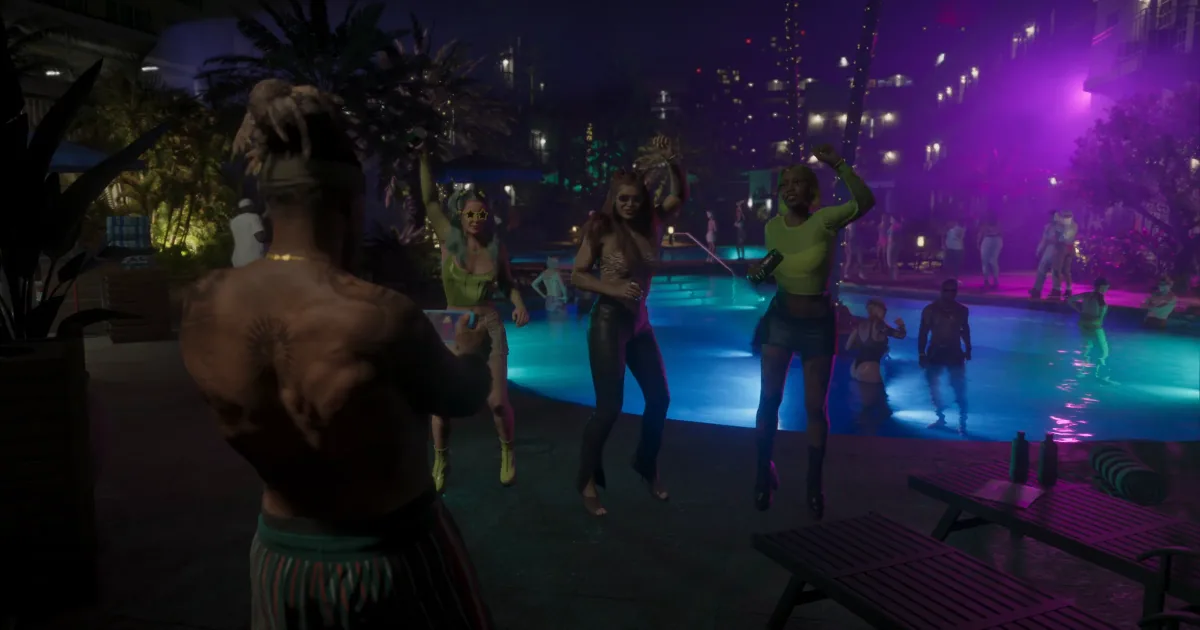
The predictable reaction to Grand Theft Auto VI's new Extended Look was that Rockstar had built an absurdly pretty game. That reaction is understandable. Vice City at night is covered in reflected neon, skin reacts convincingly to light, vehicles look almost fetishistically detailed, crowds are dense, water behaves like something more complicated than a blue surface, and Rockstar says the entire presentation was captured from in-game PlayStation 5 footage. If all you watched was the 27-minute showcase, graphical ambition would naturally seem like the main story.
Then the people who had actually visited Rockstar North began talking.
TGG described watching roughly two and a half hours of additional gameplay and came away emphasizing something quite different from polygon counts1. IGN's preview focused heavily on systems that barely register during a cinematic showcase. Breakdowns from gameranx and IGN began cataloguing details about witnesses, police descriptions, stolen vehicles, relationships, safehouses, NPC reactions and activities2. Even among reaction videos that approached the reveal more casually, the recurring observation was that GTA VI did not merely look like a prettier GTA V. Rockstar seems to be changing what it means to exist inside a GTA world.
That distinction is much more important than another generation of improved lighting.
GTA V gave you a playground. GTA VI appears to be giving the playground a memory
The basic GTA fantasy has always depended on a peculiar kind of collective amnesia. You could steal a car in front of pedestrians, drive six blocks, lose the police, abandon the vehicle and resume an ordinary afternoon as though the city had recently suffered a brief hallucination. The systems were built to produce immediate chaos rather than lasting social consequences.
GTA VI's newly described police system suggests Rockstar has spent considerable effort attacking that abstraction. A crime now needs to be witnessed or detected before the police have useful information. What the authorities know can include the suspect's appearance, clothing, vehicle and whether Jason and Lucia were seen together. A mask can therefore have an actual purpose during a robbery, and changing clothes or abandoning a known vehicle can become part of an escape rather than role-playing theater.
Think about how much that changes an ordinary convenience-store robbery. In GTA V, the interesting decision mostly begins after the police arrive: which road are you taking and how quickly can you leave the search area? In GTA VI, the interesting decisions may begin before the first dollar is stolen. Did a camera see your face? Is the getaway car identifiable? Do you have a second outfit in the trunk? Should Jason and Lucia stay together or split up once police know they are looking for a couple?
That is not graphical realism. It is systemic realism, and systemic realism has much more power to change how a game feels after the first twenty hours.

Even stealing a car is becoming a decision
This may be the strangest change in a series literally named Grand Theft Auto.
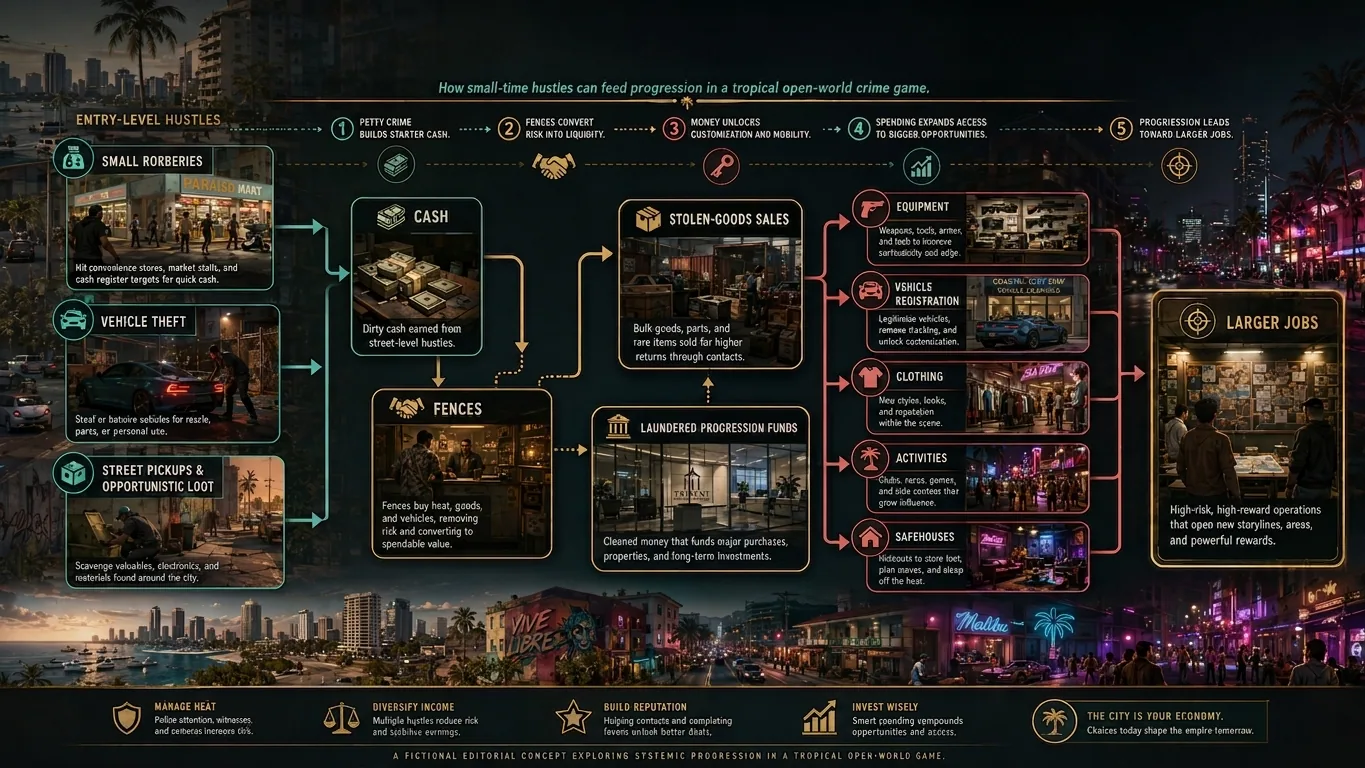
For decades, a parked car in GTA has effectively been a free vehicle with a short door-opening animation attached. GTA VI is adding security differences between vehicles. Older cars may be vulnerable to simpler tools, while modern vehicles can require equipment such as a key-cloning device. Some vehicles can contain trackers, and a phone application can reportedly help Jason or Lucia inspect information about a target vehicle before deciding whether it is worth stealing.
Rockstar has not forgotten that GTA is an action game. You can still yank somebody from an operating vehicle when you urgently need transportation. The important change concerns parked vehicles and vehicles you intend to keep or sell. A car is beginning to look less like a disposable movement speed upgrade and more like an object inside the criminal economy.
That seemingly small adjustment points toward a much broader design philosophy. GTA V usually removes friction from criminal behavior because the fun comes from escalation. GTA VI seems more interested in putting some friction back, provided that friction creates choices rather than chores.
This is the same principle TGG emphasized after his Rockstar North visit. His strongest impression was that GTA VI repeatedly asks the player to consider trade-offs rather than operating on what he described as the more mindless rhythm possible in GTA V.
Rockstar appears to have learned the right lesson from Red Dead Redemption 2
For all the obvious differences between them, GTA VI increasingly looks like a game designed by the studio that made Red Dead Redemption 2.
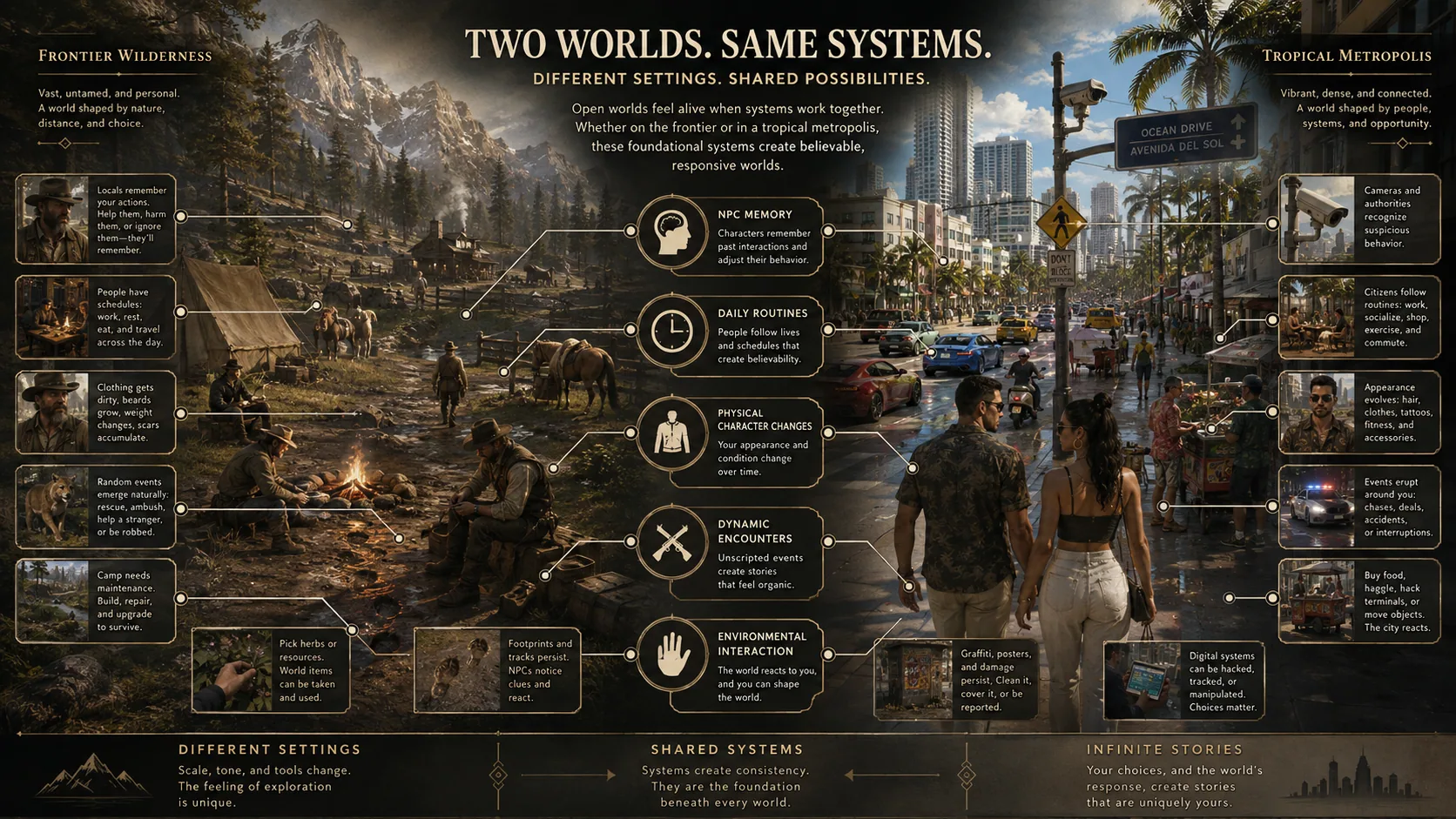
That does not mean Jason will spend fifteen seconds opening every cupboard while players scream at him to hurry up. It means Rockstar seems interested in the way Red Dead made mundane actions reinforce the illusion of inhabiting a place. Arthur Morgan could greet somebody, antagonize them, observe animals, return to a camp where characters followed routines, change his physical appearance over time and discover activities that were not screaming for attention with giant icons.
Many of those ideas appear to have descendants in GTA VI. Characters can interact with NPCs in more nuanced ways. Animals can reportedly be observed rather than existing solely as moving scenery. Jason and Lucia's hair and bodies can change according to lifestyle choices. Safehouses are described less like static save points and more like places where characters live. Optional events can be encountered through observation rather than exclusively through obvious map markers.
Rockstar seems to be taking Red Dead's density and applying it to an environment moving at seventy miles per hour.
That is a much harder problem.
Jason and Lucia are not simply GTA V's character switcher with two portraits instead of three
GTA V's three-character system was technically impressive, but Michael, Franklin and Trevor generally lived parallel lives until missions brought them together. Switching characters was primarily a way to move between perspectives, abilities and locations.
Jason and Lucia's design appears fundamentally more interdependent.
Players can operate them separately, call or text the other character, spend time together outside missions, participate in activities as a pair and nurture a relationship that can affect how portions of their story feel. When they are together in a vehicle, one can drive while the other handles shooting. During police encounters, splitting them apart can become an evasion strategy when law enforcement knows it is searching for two people.
That makes character switching part of relationships, combat, travel and police strategy rather than merely presentation.
It also gives Rockstar something GTA V never really possessed: a permanent human relationship at the center of the sandbox. The important question is no longer just "Which character do I want to control?" It becomes "What is the other character doing, what do they know, how close are these two people, and would I be better off having both of them here?"
Money may finally matter again
One of GTA V's oddest structural problems is that its criminal economy eventually becomes meaningless in the story. Characters accumulate enormous amounts of money, but the player has relatively few reasons to think carefully about ordinary expenses. GTA Online obviously went in the opposite direction and built an entire economy around accumulation, but its incentives were tied to a multiplayer service.
Preview information suggests GTA VI's single-player story is placing greater weight on money itself. Criminal jobs can apparently involve choices between acting quickly and protecting the value of stolen goods. Fences provide routes for selling stolen property and vehicles. Some progression may require capital rather than simply waiting for the next mission marker.
If Rockstar handles this correctly, it could fix one of open-world gaming's oldest problems. A simulated world becomes more believable when its shops, cars, property and criminal opportunities connect to an economy the player genuinely participates in. If money is irrelevant, half the city becomes scenery regardless of how many stores technically exist.
The smartest change may be that Rockstar wants you to notice Leonida instead of clearing it
Large open-world games have spent years becoming more efficient at helping players ignore their worlds.
Open map. Find icon. Set waypoint. Follow GPS line. Complete activity. Remove icon. Repeat until region is clean.
Rockstar appears interested in breaking some of that loop. Previewers describe events emerging from conversations and environmental behavior, NPCs reacting when they notice somebody listening or following them, and activities that can originate organically rather than announcing themselves from twenty blocks away. Rockstar has also said it wants the border between story content and open-world exploration to become less obvious.
That goal may ultimately determine whether GTA VI becomes a genuinely important open-world game or simply the most expensive implementation of existing ideas.
The industry already knows how to make enormous maps. It knows how to render beautiful streets. It knows how to cover those streets with mission icons.
What is much harder is making a player turn down an alley because something over there genuinely looks interesting.
The graphical leap will be old news within a year
This is why I suspect we are currently talking about the least durable part of GTA VI.
The screenshots will stop astonishing us. They always do. The first time we saw GTA V's Los Santos on seventh-generation hardware, it seemed ridiculous that the machines could render it. Today, nobody launches GTA V simply to admire its revolutionary shadow resolution.
Systems last longer.
If police searches remain interesting after one hundred encounters, that matters. If NPC behavior produces stories players tell each other, that matters. If Jason and Lucia feel different depending on how somebody played them, that matters. If stealing an expensive car becomes a small criminal operation rather than an animation, that matters.
Rockstar has had thirteen years since GTA V to make prettier streets. Nobody doubted it would succeed at that.
The much more interesting possibility revealed this week is that Rockstar spent those years asking what should actually happen on them.