
Old Games Really WERE Harder But Not for the Reason You Think
Old games often were harder than modern games, but difficulty wasn't always the goal. Economics, storage limits and design conventions had a lot to do with it.
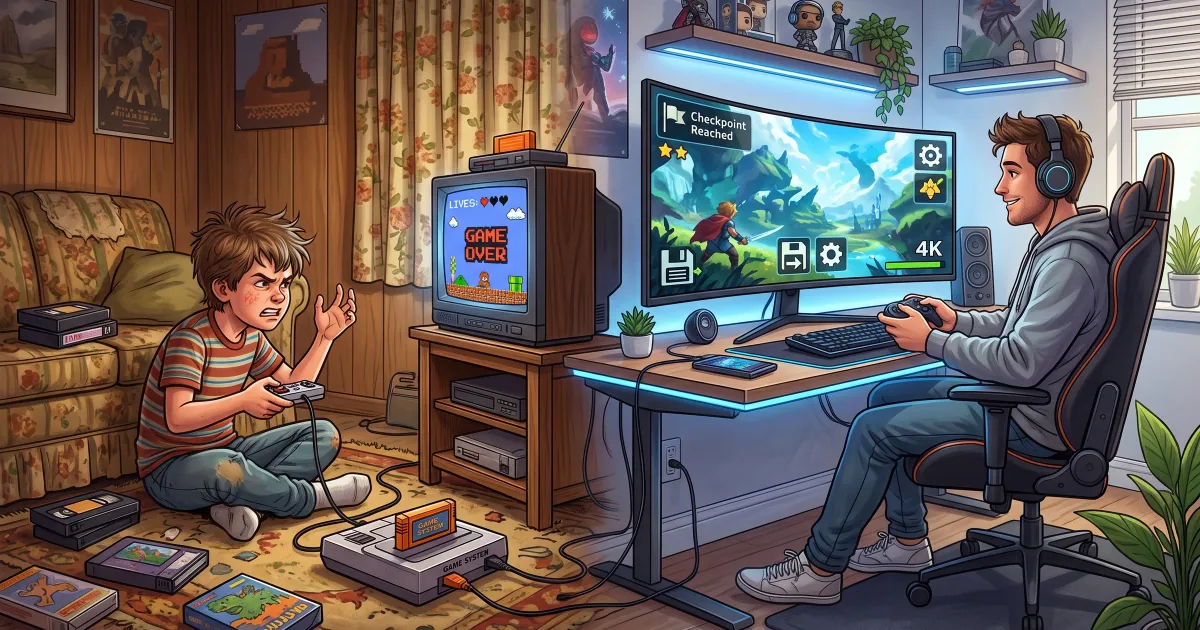
Spend enough time revisiting games from the 1980s and 1990s and eventually you encounter something that seems almost hostile.
The level starts. You die.
You try again and make it slightly farther.
Then you lose your remaining lives and the game sends you back through an enormous section you already completed.
Modern players sometimes interpret this as proof that older game designers were sadists. Older players occasionally turn the same experience into a generational morality tale: games used to require skill, whereas modern games supposedly hold everyone's hand.
Both explanations miss the more interesting story.
Many old games genuinely were harder, but they were designed inside a completely different technological and commercial environment. Difficulty was not simply an artistic choice. Sometimes it was a consequence of where games came from, how little content hardware could store and how developers stretched relatively small games into experiences that could occupy players for weeks.
The arcade left its fingerprints everywhere
Before home consoles became the center of the industry, arcades were enormously influential.
An arcade cabinet had a simple economic problem: if one player could pay once and occupy the machine indefinitely, the machine would make very little money.
Players therefore needed to lose eventually.
Difficulty could generate additional coins.
This did not mean every arcade machine was unfair or cynically designed, but the commercial environment naturally rewarded games that were easy to understand, difficult to master and capable of ending a run.
When game design moved into the home, many of those assumptions came with it. Limited lives, escalating enemy patterns, high punishment for mistakes and starting over were already part of the medium's vocabulary.
The living-room console no longer needed another quarter, but design culture does not reset overnight.
A hard game could also disguise how small it was
Early game storage was tiny.
Developers could not casually ship hundreds of hours of voiced dialogue, enormous maps and thousands of unique high-resolution assets. A cartridge might contain a relatively small number of levels by modern standards.
If players could breeze through those levels immediately, they might finish an expensive new game in an afternoon.
Difficulty became one way to create longevity.
Think about what happens when a ten-minute sequence requires twenty attempts. The developer created ten minutes of content, but the player experienced several hours of game.
That distinction matters.
Some classic games that people remember as enormous adventures are surprisingly short when played by an expert who rarely dies. Much of the original length came from learning them.
Passwords and limited saving raised the stakes
Modern games have taught us to expect progress to be preserved almost continuously.
Die during a difficult encounter and you may reappear seconds before it. Quit the game and an autosave often returns you to almost exactly where you stopped.
That dramatically changes what failure means.
Many older games had no saving at all. Others relied on passwords, limited checkpoints or save systems that preserved only broad progress rather than the player's exact state.
A mistake could therefore cost twenty minutes rather than twenty seconds.
Importantly, this makes the same mechanical challenge feel harder.
Imagine a boss that takes five attempts to learn.
If every attempt begins immediately, the boss may feel pleasantly challenging.
If every attempt requires replaying a fifteen-minute level first, the experience can feel punishing.
The boss itself did not change. The cost of practicing it did.
Old games were often worse at teaching you
There is also a less romantic explanation: games became better at communication.
Modern developers have spent decades learning how to introduce mechanics gradually, signal danger, design tutorials that feel integrated into play, build readable interfaces and communicate objectives without requiring a manual.
Old games sometimes expected the player to read the booklet in the box.
Other times they expected experimentation.
Occasionally they simply explained things poorly.
Players growing up with those games internalized conventions that may seem obvious only because they learned them through repetition. Secret walls, obscure item combinations and enemy patterns could be considered ordinary.
Returning without that accumulated knowledge can be surprisingly rough.
Controls have improved enormously
Some old difficulty isn't really difficulty at all. It is friction.
Early 3D games are particularly vulnerable to this. Developers were inventing control schemes while hardware manufacturers were inventing controllers capable of navigating three-dimensional spaces.
There was no universal agreement yet about camera controls, aiming, movement or even which direction pushing a stick should rotate a camera.
Games that were once cutting edge can therefore feel strangely resistant to your hands.
That should not automatically be confused with deliberate challenge.
There is a meaningful difference between "this enemy is difficult to defeat" and "the character is difficult to make do what I want."
Players changed too
There is another reason childhood memories of impossible games can be misleading.
When you were young, you may have owned very few games.
That meant repetition was normal.
If a level defeated you fifty times, there was a decent chance you would still boot up the same game tomorrow because you had nothing new arriving in a digital library.
Modern players operate in an environment of abundance. Subscription services, sales and enormous backlogs mean a difficult game is competing with hundreds of alternatives.
Developers know this.
A player who becomes frustrated is no longer merely deciding whether to keep playing your game. They are deciding between your game and virtually the entire history of interactive entertainment.
Yet modern games can be much harder
This is the twist that complicates the entire argument.
Old games were not necessarily more mechanically demanding at their highest levels.
Modern games have produced extraordinary difficulty: competitive shooters played at professional reaction speeds, rhythm games requiring absurd precision, complex strategy games, punishing action titles and challenge communities that transform ordinary games into near-impossible tests.
The major difference is often choice.
Modern design is more likely to offer checkpoints, difficulty settings, accessibility options or optional endgame challenges. A broad audience can finish the main experience while experts pursue something much harder.
Older games frequently put the difficulty directly across the main road.
If you could not beat the level, you did not see what came next.
So yes, old games were harder—but "harder" meant something different
The phrase "old games were harder" bundles together several different things.
Some demanded better reflexes. Some made failure unusually expensive. Some stretched limited content through repetition. Some inherited conventions from arcades. Some communicated badly. Some controlled awkwardly. Some were simply unfair.
And some were genuinely brilliant tests of mastery.
What changed over the decades was not that players became weaker or developers became afraid of challenge. The industry learned how to separate difficulty from inconvenience and how to let different players decide how much punishment they actually wanted.
The old games that still feel satisfying today tend to be the ones where the challenge survives after the inconvenience is stripped away.
The others remind us that being difficult and being good were never quite the same thing.