
Road Rash Is 35 Years Old — So Why Does It Still Feel Ridiculously Fast?
Road Rash was released in 1991, yet its motorcycle races can still feel astonishingly fast. Here’s how a 16-bit game pulled off the illusion.
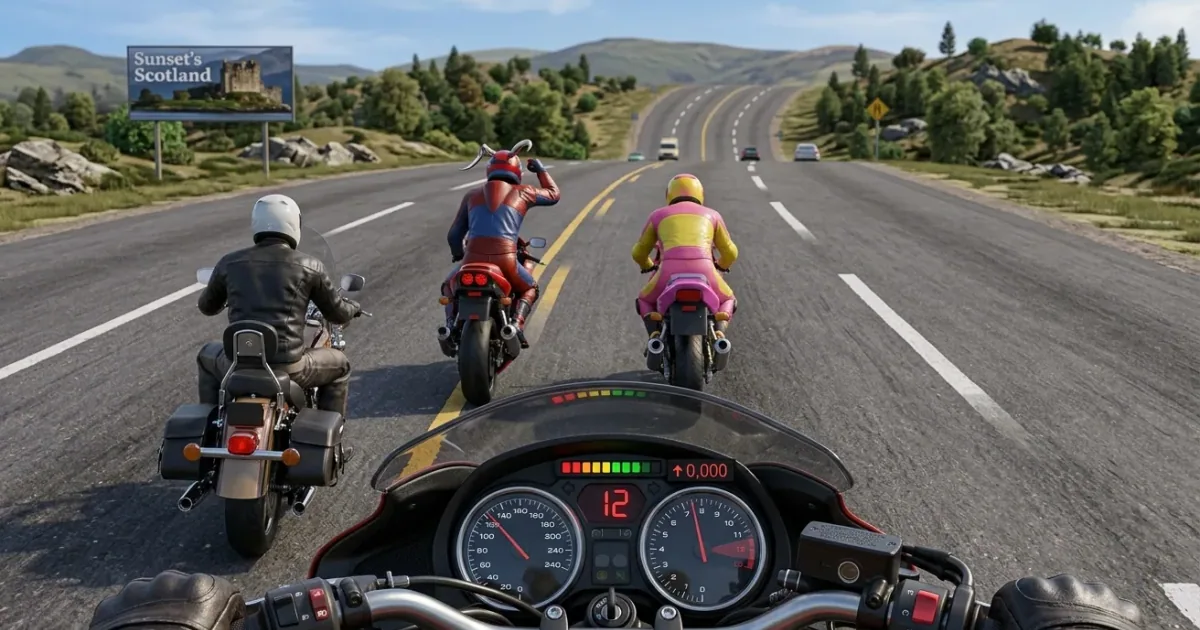
There is a funny thing that happens when you return to Road Rash after spending years playing modern racing games. Everything should work against it. The road is made from crude early-1990s graphics. The motorcycles are sprites. The scenery repeats. There are no elaborate particle systems, no physically simulated suspension, no photorealistic reflections and certainly no ray tracing. Yet once the bike gathers speed and the road begins curling toward the horizon, the game can still make you feel as though you are barely hanging on.
That is more interesting than simple nostalgia.
The original Road Rash appeared on the Sega Genesis in 1991, developed and published by Electronic Arts. It arrived at a time when home hardware was nowhere near capable of producing the kind of three-dimensional worlds that would become normal later in the decade. EA therefore had to create the impression of a long 3D road using comparatively simple graphical techniques.
Thirty-five years later, the hardware trick is obvious. What is less obvious is why the illusion still works.
Road Rash understood that speed happens around you, not in front of you
Imagine driving on a perfectly empty road across a flat desert. There are no trees, road markings, poles, buildings or other cars. Even at a high speed, the sensation of movement would be surprisingly weak because there would be very little nearby visual information against which your brain could judge your movement.
Now imagine travelling at exactly the same speed down a narrow street lined with parked cars, lamp posts and buildings. Suddenly everything feels much faster.
Road Rash is full of these visual reference points. Trees grow larger as you approach them and disappear past the edge of the screen. Signs seem to shoot past you. Opposing traffic goes from a tiny shape on the horizon to a dangerous obstacle in a remarkably short period of time. The road itself expands from a narrow strip in the distance until it occupies much of the bottom of the screen.
The player is constantly surrounded by evidence that the motorcycle is moving.
That was enormously important on hardware that could not simply brute-force realism. Road Rash did not have to calculate every detail of a physically accurate world. It merely had to provide the visual cues our brains already associate with rapid movement.
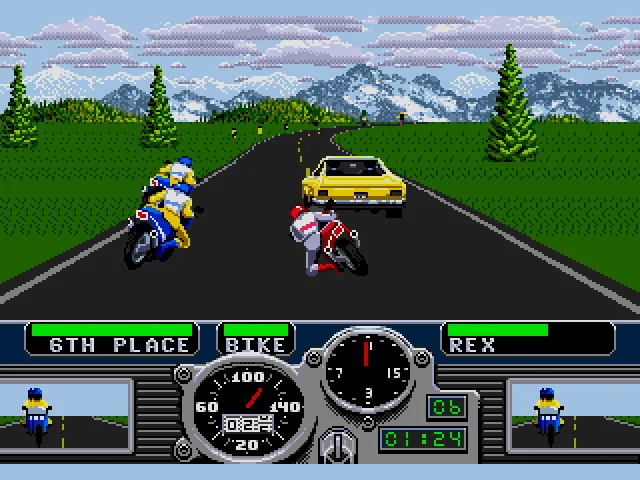
The road is doing more work than you probably remember
Another clever part of Road Rash is that the course rarely feels like a flat strip of asphalt disappearing into the distance. Hills and curves continuously change what you can see.
A crest can hide traffic until you are almost on top of it. A bend changes your line of sight. Objects appear, disappear and shift across the screen. Even when the actual underlying technology is primitive, the player's visual environment is rarely static.
This creates a constant sensation of approaching something.
Modern open-world racing games sometimes give players enormous sight distances. You may be able to see a road, an intersection or another vehicle hundreds of metres before you reach it. That looks spectacular, but it also gives the brain a lot of time to process what is coming.
Road Rash often gives you far less.
A vehicle emerges. You react. Another rider moves across you. The road bends. You make another correction.
The world feels fast partly because information is arriving quickly.
And then someone tries to knock you off the motorcycle
This is where Road Rash separates itself from an ordinary racing game.
The central idea was wonderfully ridiculous: race motorcycles at dangerous speeds while punching and kicking the people racing beside you. Later games expanded the weapons and combat, but the basic concept was already there.
Combat radically changes the player's perception of speed because it divides attention. You are no longer merely trying to keep the motorcycle on the road. You are watching the next corner, judging traffic, tracking another rider's position and deciding whether you can safely attack.
The road effectively becomes narrower because some of your mental bandwidth is being used elsewhere.
This is why an uneventful stretch of Road Rash can suddenly become chaotic when another racer pulls alongside. Your motorcycle may not have accelerated at all, but the amount of information you have to process has increased dramatically.
The experience therefore feels faster.
Old graphics sometimes make danger harder to read
There is another factor that would ordinarily be considered a limitation.
Road Rash cannot show distant objects with anything close to modern clarity. Far-away traffic begins as a small collection of pixels. You often understand exactly what you are looking at only as it gets closer.
That compressed recognition window can heighten the sensation of speed.
In a modern game running at high resolution, a player might identify a vehicle far down the road. In Road Rash, that same obstacle can seem to materialize much later. Your brain experiences less time between recognizing a threat and needing to respond to it.
The game was not deliberately hiding information as some sophisticated psychological experiment. The hardware simply couldn't produce modern visual fidelity. But the consequence happens to complement the game exceptionally well.
Frame rate isn't the whole story either
We often talk about frame rate as though it determines how fast a game feels. It certainly affects smoothness, responsiveness and motion clarity, but it is only one part of the experience.
A game running at 120 frames per second can still feel slow if the camera is distant, the environment is sparse and little changes on screen. Conversely, an old game can communicate considerable speed if nearby objects cross the player's view quickly, perspective changes aggressively and hazards demand constant responses.
Road Rash belongs to the second category.
The developers had an extremely limited visual toolbox, so they concentrated many of those tools on a single sensation: travelling much faster than seems sensible on a public road.
This is why some old games age better than their graphics
When people say that an old game "still holds up," they sometimes really mean that they remember it fondly. Road Rash is not immune to age. Returning to it today means accepting limitations that were ordinary in 1991.
But the central experience survived.
That matters because it illustrates a larger truth about games. Graphical technology ages extremely quickly; perceptual design does not.
Developers in the early 1990s already understood that making a vehicle look fast was not simply a question of displaying a large number on a speedometer. They needed motion near the edges of the screen, rapidly changing scale, an aggressive perspective, limited reaction time and enough danger that the player actually cared about what was coming.
Road Rash happened to combine all of them.
The Genesis could never convincingly recreate what riding a motorcycle at extreme speed actually looked like. Instead, Electronic Arts found something arguably more important.
It recreated enough of what speed feels like that, thirty-five years later, your brain is still willing to believe it.