We Used to Write Save Passwords on Paper. Now Your Game Follows You Around the World
From passwords scribbled in notebooks to memory cards, hard drives and Steam Cloud, here's how saving a game evolved over four decades.
There is an entire generation of players for whom "saving a game" means doing absolutely nothing.
They finish playing, close the application and reasonably assume that when they return tomorrow the game will remember where they were.
This expectation is so deeply embedded in modern design that losing several hours of progress feels like a software failure.
Older games trained players to expect almost the opposite.
Some games did not remember anything.
Some remembered only if you left the machine switched on.
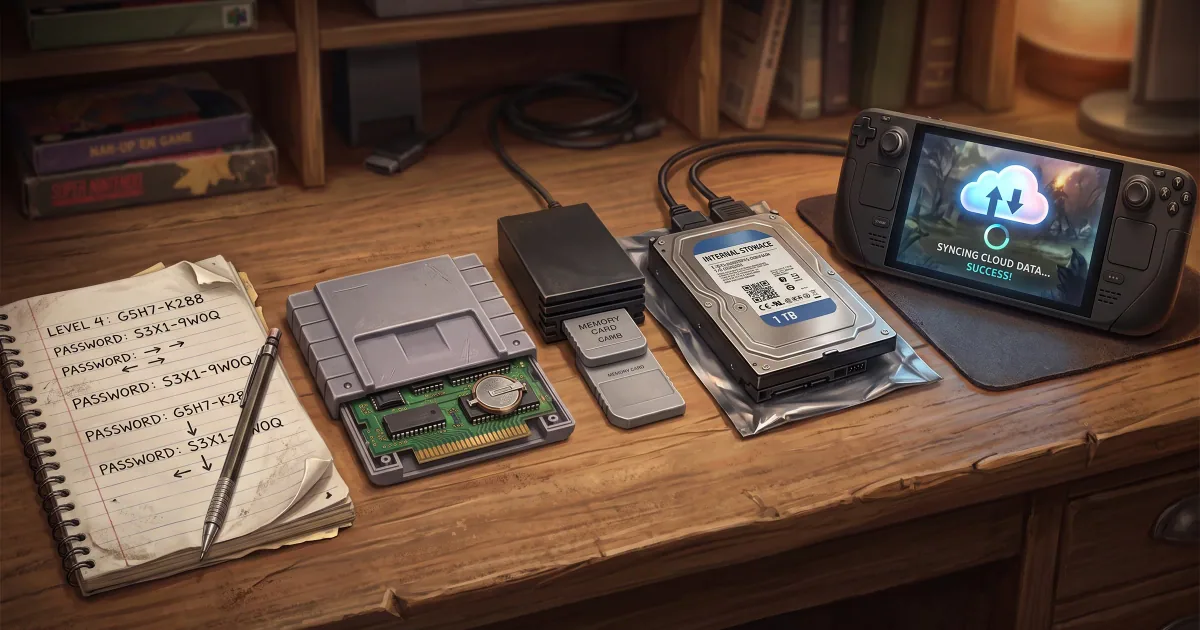
Some gave you a long sequence of letters and numbers that you were expected to copy correctly onto a piece of paper.
Then came batteries, floppy disks, memory cards, hard drives, online accounts and cloud synchronization.
The history of game saving is quietly the history of storage becoming cheap, reliable and invisible.
In the beginning, turning the machine off could erase your entire adventure
Early game consoles had no general-purpose storage device available to every game.
A cartridge contained the software in nonvolatile memory, but that did not automatically mean it had somewhere writable to store the player's changing progress.
For short arcade-style games, this was not necessarily a problem.
Pac-Man does not require a fifty-hour character save.
As console games became longer and more elaborate, however, designers needed a way to let players continue later.
One surprisingly elegant answer was the password.
A save password isn't really a save file
Suppose a game needs to remember only a handful of facts: which level you reached, which items you possess and perhaps your current statistics.
Instead of writing that information to storage, the game can encode it into a string.
You finish playing and receive something like:
X7K4-PQ2L-9B
When you return, entering the password reconstructs the state represented by those characters.
The game has not remembered you.
You are carrying the memory yourself.
That is a wonderfully strange solution when viewed from today's perspective.
It was also practical. Password systems required no battery or external storage device.
The cost was transferred to the player, who had to copy the code accurately.

The password notebook became part of playing
Anyone who used these systems remembers the anxiety.
Was that a zero or the letter O?
An uppercase I or lowercase L?
Did you copy the fifth character correctly?
A single mistake might render the password useless.
Families kept notebooks. Codes appeared on scraps of paper. Players sometimes discovered that a carefully recorded password no longer worked because the handwriting was ambiguous.
From a software perspective this was an ingenious storage mechanism.
From a human-interface perspective it was terrifying.
Battery-backed cartridges changed everything
The more satisfying solution was to give the cartridge a small amount of writable memory and keep it alive with a battery.
Now the game could remember progress internally when the console was switched off.
For lengthy adventures and role-playing games, this was transformative. The player's relationship with the game changed because progress began to feel persistent rather than temporary.
The disadvantage became visible decades later: batteries eventually die.
Retro-game collectors now encounter cartridges whose original save hardware has outlived expectations but not chemistry. Replacing ageing batteries has become part of game preservation.
Computers had an easier time
PC games operated in a different environment.
Personal computers already had writable disks and eventually hard drives, so games could create save files like ordinary software.
That opened the door to far richer stored states.
Rather than encoding "the player reached level six," a PC game could record the exact position of characters, inventory, world variables and numerous other details.
Some games eventually offered quicksave, allowing players to preserve the current state with a key press and restore it almost instantly.
That convenience would create its own design debates. If players can save before every dangerous action, how should a game create tension?
Technology was beginning to influence game design in the opposite direction: storage was no longer restricting designers; abundant saving was changing player behavior.
Memory cards made saves portable
The move toward disc-based consoles introduced another problem.
A CD or DVD is excellent for distributing large amounts of game data, but ordinary pressed game discs are not writable by the player.
Consoles therefore adopted separate storage.
The memory card became one of the defining objects of the PlayStation era and beyond.
This had an accidental benefit: your save became physically portable.
Bring the card to a friend's house and you could bring your progress with you.
It also created an entirely new category of tragedy.
You could lose the memory card.
You could accidentally overwrite the wrong save.
It could become corrupted.
And storage capacity was limited enough that players sometimes had to decide which game's memories were worth keeping.
Internal console storage eventually made the card unnecessary
As hard drives and flash storage became standard inside consoles, dedicated memory cards gradually disappeared from their central role.
Games could keep more data without asking the player to manage tiny blocks of storage manually.
Saving also became increasingly automatic.
Developers could create checkpoints when the player entered an area, completed an objective or changed equipment. The spinning autosave icon quietly became one of the most reassuring symbols in gaming.
Saving stopped being a discrete action and became infrastructure.
Then saves left the machine entirely
Cloud synchronization completed the transformation.
Steam Cloud, for example, can automatically store selected game files on Steam's servers and synchronize them when a player moves between computers. Valve's developer documentation describes saves being uploaded after a session and downloaded on another computer before the game launches.
Modern consoles offer related functionality through their online ecosystems.
The player can replace a device and, in compatible circumstances, discover that progress simply reappears after signing into an account.
Compare that with copying a twelve-character password onto paper.
The difference is enormous.
Cloud saves also created new problems
Convenience does not eliminate complexity.
Two machines may modify the same save independently.
A synchronization conflict can leave the service asking which copy should survive.
Offline play complicates assumptions.
Games sometimes store settings alongside progress that shouldn't necessarily move between hardware configurations.
Corruption can propagate if the wrong file synchronizes.
The storage problem was solved so thoroughly that the new challenge became deciding which version of memory is authoritative.
The save system changed how games themselves are designed
This is the most important part of the story.
Saving isn't merely a technical feature surrounding the game.
It influences the game.
A title with no saving can demand mastery and repetition.
A title with distant checkpoints makes individual encounters feel dangerous.
A game with unrestricted quicksaving allows experimentation because failure costs almost nothing.
An autosaving open-world game encourages wandering because the player rarely worries about preserving progress manually.
A roguelike might deliberately prevent conventional saving because permanent consequences are part of its identity.
The same challenge can feel completely different depending on how much progress death removes.
That means the evolution from passwords to cloud saves wasn't just an improvement in convenience.
It helped reshape the medium.
We began with games that forgot everything the moment electricity disappeared.
Today we consider it perfectly normal to stop playing on one machine, travel hundreds of miles, open another machine and continue from almost the same moment.
The save file has gone from something the game could barely preserve to something the player barely has to think about.
That may be one of gaming's most successful technological advances precisely because, when it works properly, we no longer notice it exists.