
Your GPU Says 240 FPS. How Many of Those Frames Are Actually Real?
DLSS 4.5 can generate multiple frames for every rendered frame. AMD and Intel now have similar technology. But does generated FPS really count?
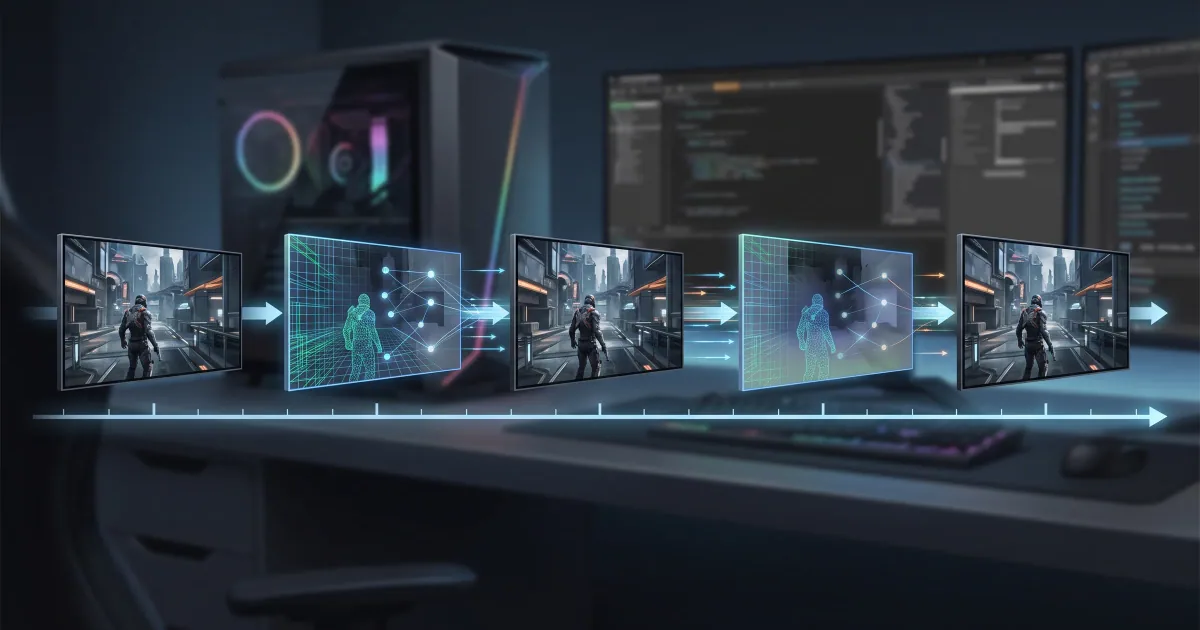
If your game reports 240 frames per second, the obvious assumption is that your computer rendered 240 frames.
That assumption is no longer safe.
Modern graphics systems can insert entirely new images between traditionally rendered frames. Nvidia's DLSS 4.5 can generate as many as five additional frames for every traditionally rendered frame on supported RTX 50-series hardware. AMD's FSR "Redstone" includes machine-learning frame generation, and Intel's XeSS 3 similarly supports multi-frame generation with up to three AI-generated frames.
This produces enormous numbers on frame-rate counters.
It has also started one of the most confused arguments in PC gaming: Are generated frames fake?
The answer depends on what you think a frame-rate number is supposed to tell you.
A traditionally rendered frame contains new game simulation
In ordinary rendering, the game calculates the state of its world, processes input and prepares a new image based on that state.
If the player turns the camera, the next frame reflects the movement.
If an enemy moves, its new position can be represented.
If the game runs at 60 fps, a new traditionally rendered frame arrives roughly every 16.7 milliseconds.
Frame generation works differently.
Instead of asking the game simulation to produce another complete frame, the system studies surrounding rendered frames, motion data and other information, then synthesizes intermediate images that make the visual sequence appear smoother.
Those generated frames are absolutely real pixels on your screen.
What they are not is new game simulation.
That distinction explains almost everything.
Why generated FPS can improve smoothness without improving responsiveness equally
Suppose a game natively renders at 60 fps and frame generation produces enough intermediate images to display 120 fps.
Visually, movement can look much smoother because the display receives more unique images.
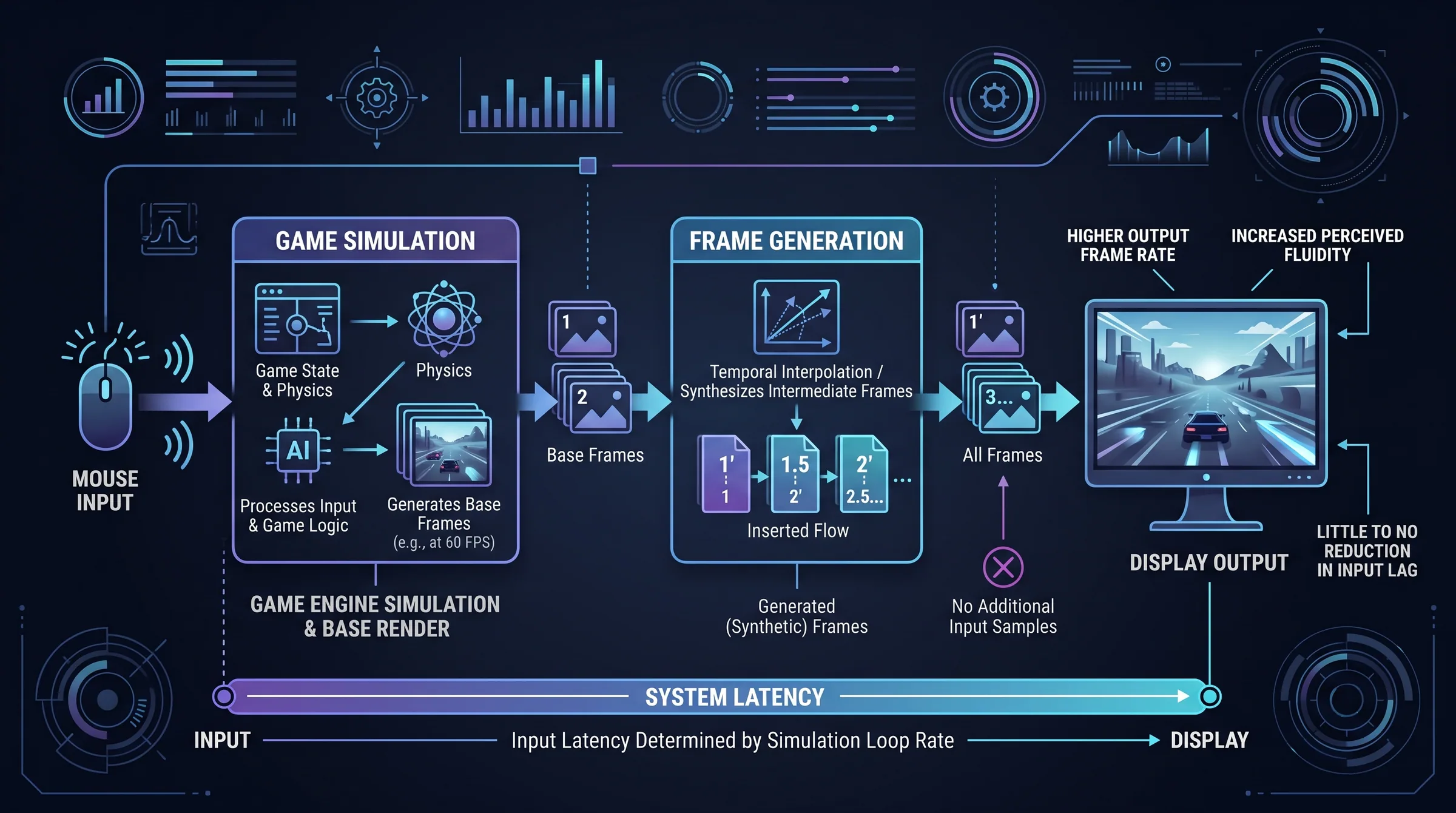
Your input, however, is still fundamentally connected to the rate at which the game is rendering and updating its true frames.
A generated image inserted between two rendered frames cannot travel backward in time and make the game process your mouse click earlier.
This is why frame-generation technologies are usually paired with latency-reduction systems such as Nvidia Reflex or Intel Xe Low Latency. Nvidia explicitly positions Reflex alongside frame generation because generating additional visual frames without controlling the rest of the rendering queue could make responsiveness worse.
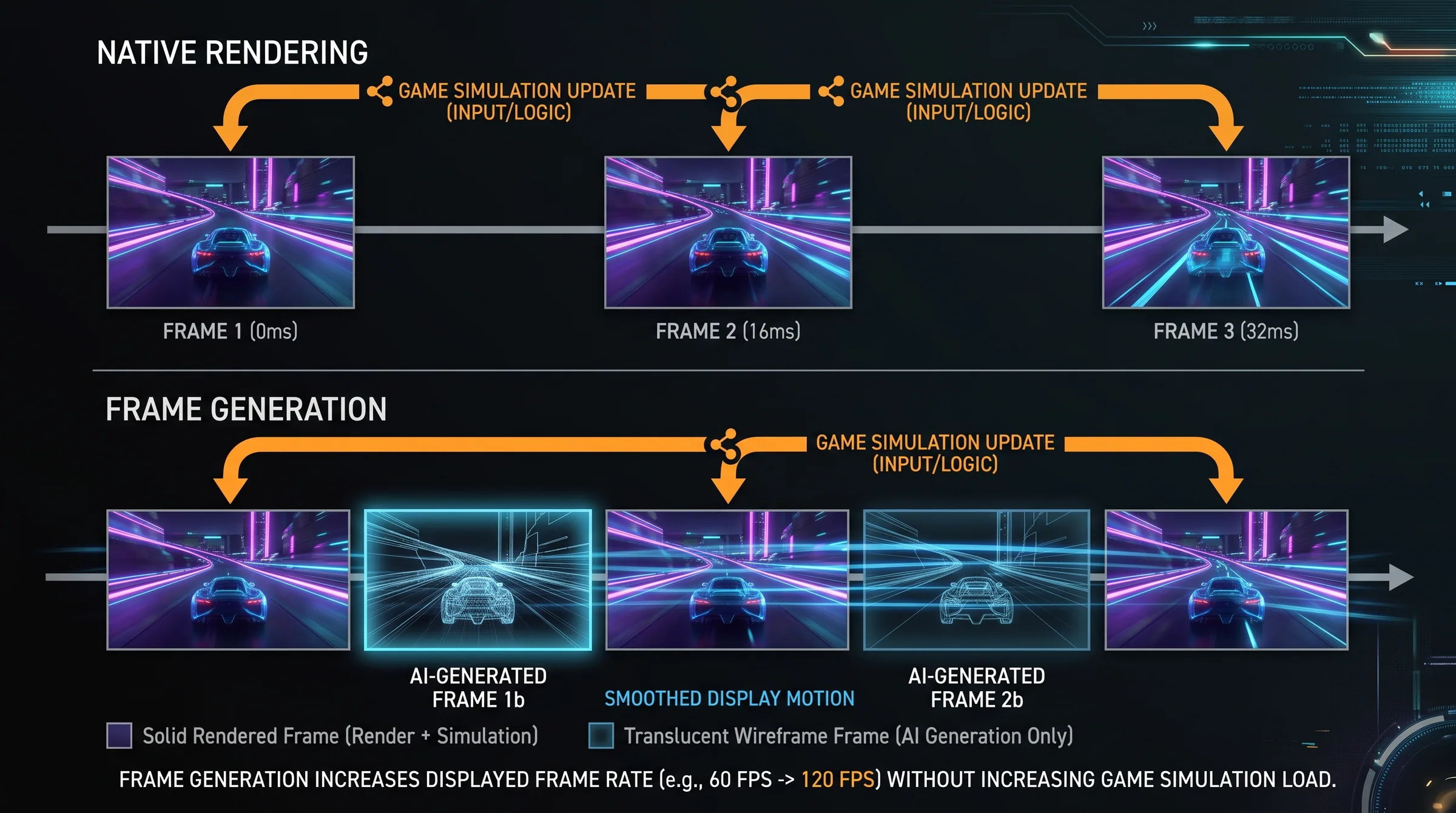
Top row shows Rendered Frame A, Rendered Frame B, Rendered Frame C. Bottom row shows the same rendered frames with several visually reconstructed intermediate frames inserted between them. Clearly communicate that the generated frames improve display motion while simulation updates still occur only on the rendered frames. Clean dark infographic, 16:9.
DLSS 4.5 makes the numbers look almost absurd
Nvidia introduced multi-frame generation with DLSS 4, initially allowing the system to create several additional frames between traditionally rendered images.
DLSS 4.5 goes further.
On compatible RTX 50-series GPUs, the new 6X mode can generate five frames for every traditionally rendered frame. Nvidia says its Dynamic Multi Frame Generation can also vary the multiplier depending on conditions.
Imagine a game whose underlying rendering rate is around 40 fps.
Multiply the displayed output aggressively enough and the counter can move into the hundreds.
That does not mean the game suddenly responds like a native 240 fps competitive shooter.
It means the presentation layer has become much smoother.
For slow camera movement in a visually demanding, path-traced single-player game, that can be extremely valuable.
For competitive Counter-Strike, it would be a very different proposition.
This is why the starting frame rate matters
Frame generation works best when it begins with a reasonably healthy native rendering rate.
At very low base frame rates, two problems become more visible.
First, responsiveness remains constrained by the slow underlying rendering cadence.
Second, the generator has larger temporal gaps to bridge. When objects move unpredictably, particles appear, UI elements change or the camera swings quickly, synthesizing convincing intermediate frames becomes harder.
Nvidia's own DLSS research discusses challenges involving complex motion and particles, and the company has continued changing the model to improve generated-frame quality.
This leads to a useful practical rule: frame generation is best treated as a multiplier of a good experience, not a replacement for achieving an acceptable underlying frame rate.
Taking 70 fps to something visually closer to 140 fps can feel excellent.
Taking a barely responsive 20 fps game and generating your way to a three-digit counter does not solve the underlying problem.
AMD and Intel are converging on the same idea
Nvidia may have popularized the modern version of frame generation, but the broader industry direction is obvious.
AMD's FSR Redstone suite now combines machine-learning upscaling, frame generation, ray regeneration and other rendering technologies. AMD describes its frame-generation component as predicting and inserting new frames between rendered ones.
Intel's XeSS 3 includes its own AI-based frame interpolation and multi-frame generation.
The important story is therefore larger than any single vendor.
Graphics rendering is moving from a world where every displayed pixel was conventionally calculated from scratch toward a hybrid world where some information is rendered, some reconstructed and some generated.
We already accepted this transition with resolution.
DLSS, FSR and XeSS can render internally below the display resolution and reconstruct a higher-resolution image.
Frame generation extends the same philosophical change into time.
Is a generated frame "fake"?
Calling it fake is emotionally satisfying but technically unhelpful.
Every game frame is already artificial.
The geometry is approximated.
Lighting is approximated.
Textures fake geometric detail.
Temporal anti-aliasing reuses information from previous frames.
Upscaling reconstructs pixels that were not directly rendered at output resolution.
Ray reconstruction estimates lighting from sparse samples.
Game graphics have always been an elaborate collection of shortcuts.
The relevant question is whether the shortcut preserves the information you care about.
For visual smoothness, generated frames can be highly effective.
For fresh simulation state and immediate input response, they do not carry the same meaning as native frames.
So when a benchmark says "240 fps with frame generation," that number should not be interpreted identically to 240 traditionally rendered frames per second.
Both measurements are useful.
They are measuring different experiences.
Frame counters need to become more honest
The industry now has a communication problem.
For decades, "fps" roughly meant how many game frames the machine rendered each second.
When generated frames are included, the number becomes a measure of displayed image cadence instead.
A useful benchmark should therefore tell you at least two things:
the underlying rendered performance,
and the final displayed performance with generation enabled.
Latency should ideally be measured separately.
A game running natively at 85 fps and displaying 170 fps through frame generation tells you far more than the single number "170 fps."
It tells you that the foundation is already responsive and frame generation is adding visual fluidity.
Generated frames are neither a scam nor free performance
They consume GPU resources.
They can create visual artifacts.
They can complicate UI rendering.
They do not provide the same latency characteristics as conventionally rendered frames.
At the same time, dismissing them because the images are generated ignores what your eyes actually receive.
If a technology makes a demanding game look substantially smoother while keeping latency within a comfortable range, that improvement is real even if the method is not equivalent to rendering twice as much game simulation.
The better way to think about frame generation is not "real frames versus fake frames."
Think of two different rates.
One is how often the game genuinely updates and renders its world.
The other is how frequently your display receives a new image representing that world.
For most of gaming history, those numbers were nearly the same.
In 2026, they no longer have to be.